Crypto Regulatory Clarity is Now a Competitive Advantage. Japan Just Secured Its Own.
By Asheesh Birla, CEO, Evernorth
On July 15, Japan’s government did the thing the world’s deepest capital markets have spent most of the past decade avoiding. It wrote down its own rules for crypto.1
Lawmakers pulled crypto out of the country’s payments statute and placed it under the Financial Instruments and Exchange Act, the same body of law that governs stocks and bonds. The reform includes an insider-trading ban, imposes disclosure obligations on issuers, and increases the maximum prison term for running an unregistered crypto business from three years to 10.2 It also opens the door to spot crypto ETFs on the Tokyo Stock Exchange, which the exchange group is targeting for 2027 or 2028, and cuts the top rate on crypto gains from roughly 50% to a flat 20%.3
None of these reforms are exotic. Disclosure, custody standards, a prohibition on trading with inside information. This is the ordinary plumbing of a securities market.
Japan simply made a decision. Other countries are lagging and paying for it, in the capital and talent that leave and the participation they never attract in the first place.
Take the United States, which for years has regulated digital assets mostly through litigation. The bill for that approach is observable in the data. In 2015, approximately 40 percent of the world’s open-source crypto developers worked in America. By 2025, that share had dropped to 16 percent, and the majority of the industry’s builders now sit outside the country entirely.4 Engineers are mobile, and they have been migrating toward places willing to tell them what the rules are.
Capital has done the same. Coinbase, the largest American exchange, spent 2023 securing a license in Bermuda and building offshore derivatives infrastructure, while its chief executive praised Europe and Britain for a more thoughtful approach than the one he encountered at home.5 When your marquee domestic firm starts describing another continent as the reasonable one, the problem has stopped being theoretical.
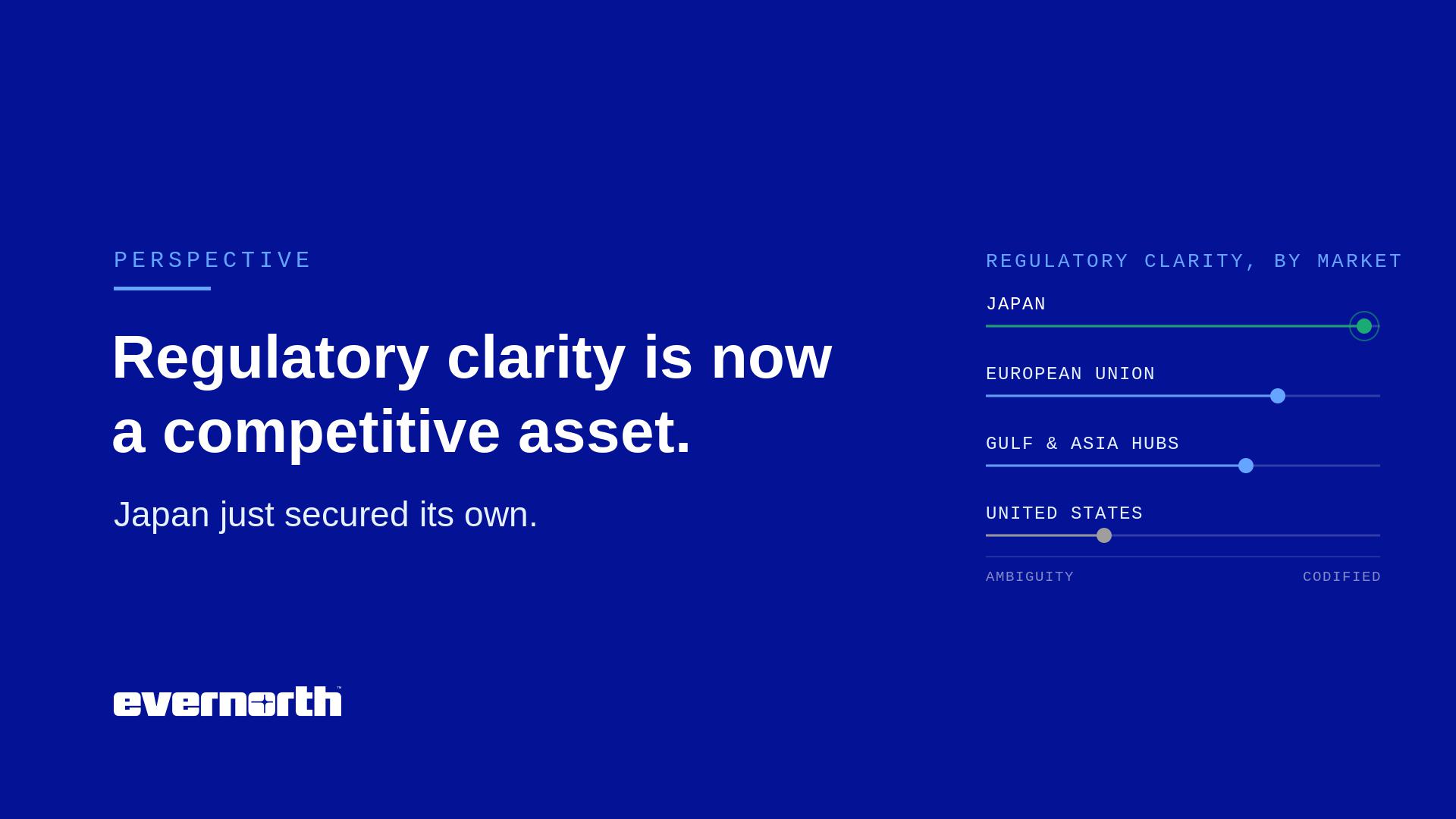
Europe, for its part, picked certainty. Its Markets in Crypto-Assets regulation, which went into effect at the end of 2024, handed firms a single licensing framework to build against.6 Dubai stood up a dedicated virtual-asset regulator; Hong Kong and Singapore wrote formal licensing frameworks of their own.7 Several of these frameworks are more prescriptive than anything on offer in the U.S. But they codified, and in finance, codification is itself a form of infrastructure.
This is the point the laggards keep missing. The contest among financial centers was never about who could regulate the least. It was about who could be clearest. Money doesn’t need permission to take risk; it needs the ability to price risk, and you cannot price a rule that has not been written. The regulatory uncertainty in the U.S. is working like a tax, collected in firms that incorporate abroad, engineers who take the offer overseas, and listings that land on someone else’s exchange.
Japan’s reform matters because it turns years of official hedging into something a balance sheet can actually use. Once crypto is regulated under the same framework as securities, a Japanese pension fund or corporate treasurer can underwrite the asset the way they underwrite everything else, against a known rulebook. The ETF pathway and the tax cut follow from that first phase of definition.
And the effect can compound. Institutional capital deepens order books that make a market worth trading. That liquidity attracts builders, builders ship products people actually use, and the volume they generate can convince the next allocator to commit. Clear rules can start a cycle.
Each year a serious market spends “studying” digital assets is a year when its talent compounds elsewhere and its firms book their growth under another flag. Capital is quietly accumulating in the geographies where the next financial systems are being built.
Japan's institutions aren't waiting. Established names like SBI have already been building for a regulated crypto market. But regulatory clarity now gives more serious capital permission to move. What follows is scale, and only a rulebook unlocks it. The markets still hesitating should remember that hesitation is a choice too, and, increasingly, a costlier one.
This content is for informational purposes only and does not constitute an offer to sell or a solicitation of an offer to buy any securities, nor does it constitute investment advice. It reflects the personal views of the author. This content may contain forward-looking statements that involve risks and uncertainties; actual results may differ materially. Digital assets involve risk, including potential loss of principal. Evernorth has filed a registration statement (available at sec.gov) with the SEC in connection with a proposed business combination. Learn more about Evernorth: https://www.evernorth.xyz/blog-post-03-18-2026
Endnotes
- “Japan reclassifies crypto as a financial asset, paves way for tax cuts,” CoinDesk, July 15, 2026. Japan’s National Diet gave final approval to amendments to the Financial Instruments and Exchange Act and the Payment Services Act; the new rules are expected to take effect in 2027. https://www.coindesk.com/policy/2026/07/15/japan-reclassifies-crypto-as-a-financial-asset-paves-way-for-tax-cuts
- Ibid. The legislation introduces insider-trading rules and expanded issuer disclosure, and raises the maximum prison term for unregistered crypto operators from three years to ten (maximum fine raised from ¥3 million to ¥10 million). https://www.coindesk.com/policy/2026/07/15/japan-reclassifies-crypto-as-a-financial-asset-paves-way-for-tax-cuts
- Ibid. on the ETF pathway and the approved plan to cut the top crypto tax rate from as much as 55% to a flat 20% (effective 2028); Japan Exchange Group is targeting spot crypto ETF listings on the Tokyo Stock Exchange in 2027–2028. https://www.coindesk.com/policy/2026/07/15/japan-reclassifies-crypto-as-a-financial-asset-paves-way-for-tax-cuts
- Electric Capital, Developer Report (2023). The U.S. share of open-source crypto developers fell from roughly 40% in 2018 to 26% in 2023, with the majority of active developers now based outside the United States. https://www.developerreport.com/
- “US Crypto Firms Eye Overseas Move Amid Regulatory Uncertainty,” CoinDesk, March 27, 2023. Coinbase obtained a license from the Bermuda Monetary Authority for its offshore derivatives exchange; CEO Brian Armstrong publicly praised the EU and UK approaches to crypto regulation. https://www.coindesk.com/consensus-magazine/2023/03/27/crypto-leaving-us
- European Securities and Markets Authority (ESMA), “Markets in Crypto-Assets Regulation (MiCA).” MiCA became fully applicable across the European Union at the end of 2024, establishing a single harmonized licensing regime. https://www.esma.europa.eu/esmas-activities/digital-finance-and-innovation/markets-crypto-assets-regulation-mica
- On the Dubai (VARA), Hong Kong (SFC) and Singapore (MAS) licensing frameworks, see TRM Labs, Global Crypto Policy Review & Outlook 2025/26. https://www.trmlabs.com/reports-and-whitepapers/global-crypto-policy-review-outlook-2025-26