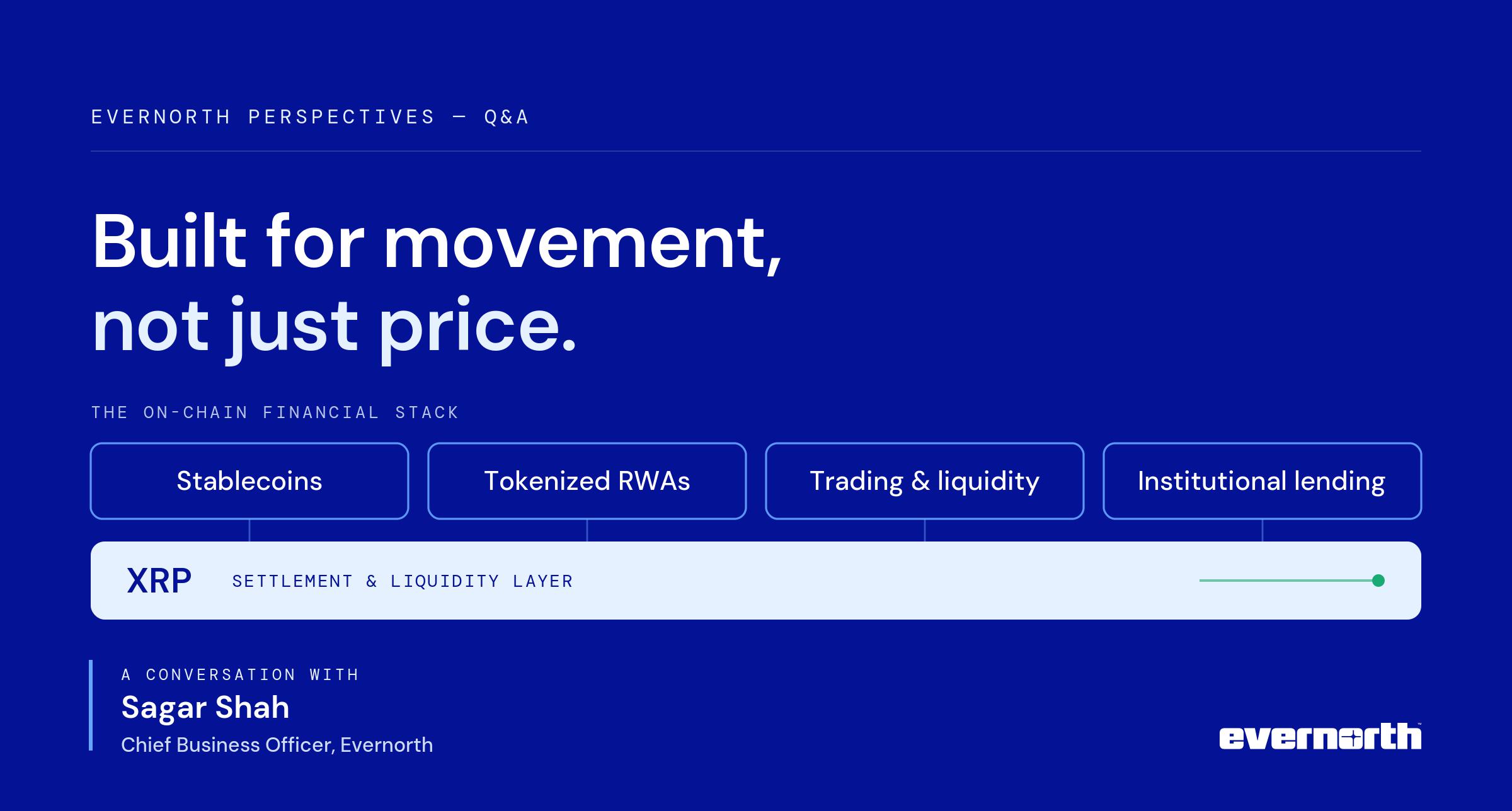
Why Was XRP Built? For Movement, Not Just Price
Most crypto assets are judged primarily by price: what they are worth today and how that value could change. Yet, XRP is better understood by what it was built to do.
XRP was designed to address friction in moving value and quick settlement at low costs. Today, that opportunity set is more expansive. As the XRP Ledger (XRPL) supports stablecoins, tokenized real-world assets (RWAs), decentralized exchanges, and develops additional institutional lending capabilities, XRP can play a larger role as liquidity and working capital within the global financial system.
In short: XRP is designed to help value move quickly across currencies, markets and financial systems. Its usefulness depends less on price and more on whether it supports real liquidity, settlement, lending and tokenized asset activity on the XRPL.
Sagar Shah, Chief Business Officer of Evernorth, shares why movement remains central to XRP’s value proposition, why liquidity matters for institutional adoption, and what must happen for the asset to become a more productive and mainstream part of financial infrastructure.
Q: Why is XRP still mostly discussed as a price story when its original design was about market movement?
Price is the easiest part of any digital asset to see. It updates constantly, gives people a similar comparison point to traditional markets, and naturally drives headlines. Utility, however, is harder to capture in one number.
XRP was designed to be financial infrastructure. Think of it as a foundation for moving, settling and building on top of value in real time. On the XRP Ledger, transactions generally settle within seconds at very low cost, which makes it practical for far more than payments. Trading and liquidity provision, lending, tokenized assets like U.S. Treasuries, and a dollar stablecoin that its issuer represents as fully reserved can all live in the same ecosystem.
So the better question is not only “what is XRP worth?” but, “What can XRP make possible?” The signal is ultimately in how the asset is used, not only how it trades.
Q: What does XRP enable that traditional financial infrastructure still struggles to deliver?
Traditional financial systems are often disjointed across institutions, currencies, jurisdictions, and operating hours. What looks like a simple payment to one customer can still involve multiple intermediaries, pre-funded accounts, separate systems, and reconciliation behind the scenes.
The XRPL offers a shared network that operates continuously, with transactions that generally settle within seconds and at a low cost. XRP can also provide the connective liquidity between currencies or tokenized assets when a direct market is limited.
That does not remove the need for custody, compliance, or integration. It just gives institutions a more efficient set of rails for moving value across systems and marketplaces.
Q: Why does liquidity matter more than narrative for institutional adoption?
Institutions need to know they can actually use a market at the scale they require.
A strong story may attract attention and capital, but liquidity determines whether an asset can support payments, trading, treasury activity, and exchange between different markets. Without sufficient liquidity, even good assets have limited use.
At Evernorth, we view liquidity as core market infrastructure. Deeper, more reliable markets make it easier for institutions to enter and exit positions, move value, and use XRP as a bridge asset. Institutional adoption tends to begin when the market can support real activity, not just attention.
Q: What changes when XRP is treated as working capital in a modern treasury rather than passive exposure on a balance sheet?
A passively held asset is mainly for exposure, while working capital has a job to do.
Once you start thinking about XRP as treasury capital, the conversation changes. Can it support liquidity? Can it facilitate a payment? Can it connect on-chain markets? Can it support institutional lending?
That distinction is central to Evernorth’s business. Evernorth's own operations may include liquidity provisioning, institutional lending, and participation in the tokenized markets developing on the XRPL.
Q: How do stablecoins, tokenization and on-chain lending change the role XRP can play?
They bring more assets and financial activity on-chain, which creates a greater need for liquidity and connectivity between markets.
Stablecoins such as Ripple’s USD-denominated stablecoin, RLUSD, bring familiar fiat value into blockchain infrastructure. Tokenization brings funds, credit vehicles, and other real-world assets on-chain, while emerging lending protocols could create new ways for institutions to borrow, lend, and deploy capital.
XRP can serve as a routing and liquidity layer across those markets. As more stablecoins and tokenized assets are issued on the XRPL, XRP can help connect pools of value that might otherwise be fragmented.
What this actually means in practice is that XRP’s role can expand beyond a single cross-border payment. It can help capital move among payments, tokenized assets, trading venues, and lending markets.
Q: What will determine whether XRP is more widely used as financial infrastructure?
Technology alone will not be enough. Regulations and capital also need to be a part of the conversation.
The technology arrived first. Institutions now have growing access to regulated custody, investment products, and tokenized assets, while the XRPL is adding more of the controls, settlement capabilities, and market infrastructure that regulated capital requires.
But infrastructure only matters when it’s put to use. XRP and the XRPL must improve real financial processes, whether that means reducing stagnant liquidity, making settlement more efficient, or allowing treasury capital to work continuously.
The real test lies in utility: more institutions participating, more assets moving, and more financial activity taking place on the network.
Q: If XRP has existed for more than a decade, why is institutional adoption only accelerating now?
Technology is only one piece of financial infrastructure. Institutions also need regulatory clarity, trusted custody providers, deep liquidity, compliant counterparties, and products that integrate with existing treasury and operational workflows.
Many of those pieces have only recently begun to come together. The emergence of regulated stablecoins, tokenized assets, stronger custody solutions, and clearer regulatory frameworks has made it more practical for institutions to evaluate blockchain infrastructure as part of their core financial operations.
That is why the conversation is shifting from whether digital assets have a place in institutional finance to how they can improve the movement of capital.
Q: What is the biggest misconception about XRP today?
The biggest misconception is holding XRP is only a bet on price.
Price matters, but it does not explain why XRP was created or how it is used. XRP was built for movement and to help value travel across currencies, assets, and financial networks.
Most people are still watching the charts. We are watching the utility: the liquidity, regulated access, tokenized assets, and financial use cases developing around the XRPL.
The next chapter for XRP is an infrastructure story. Evernorth’s role is to help make the infrastructure more useful by using XRP in its own operations. This describes Evernorth's business and is not a prediction about XRP's price or value.
This content is for informational purposes only, does not constitute investment, legal, or tax advice, and is not an offer to sell or a solicitation of an offer to buy any security or digital asset. It may contain forward-looking statements that involve risks and uncertainties; these are not guarantees of future results. For risks and information about Evernorth's business, refer to Evernorth's filings with the SEC. Digital assets involve substantial risk, including the potential total loss of principal. Evernorth holds digital assets, including XRP, as treasury assets and may benefit from favorable market conditions for those assets. The views expressed are those of the interviewee as of the date of publication.