WHY WE PUBLISH THIS REPORT
Financial markets require diligent record keeping. For most of the last century, the record that says who owns a bond, a fund share, or a dollar has lived in a centralized database at a custodian, a transfer agent, or a bank, and the system has worked by reconciling those databases against each other after the fact. That reconciliation is why a trade can take days to settle, why collateral is slow to move, and why the plumbing of finance can become expensive. Tokenization is a way of moving those records onto shared ledgers, where the record and the asset are the same thing and can move at the speed of a message on the blockchain. It’s a project we track.
Nine in ten tokenized dollars can't move yet. The XRP Ledger is building the venues where they can.
The first era of tokenization has meaningfully progressed. Approximately $400 billion of real-world assets have been tokenized, alongside nearly $300 billion of U.S. dollar stablecoins, and regulated asset managers have shown a fund can exist on a public ledger. But a record on a ledger is not yet a market. Only about $39 billion of that value can be traded, settled, or pledged on the chain that holds it; the other $363 billion is a register, with the asset itself still changing hands off-chain.1
The second era of tokenization is shaping up to be about utility: an asset that settles against cash in one step, can be used as collateral, and trades in a venue limited to participants who have been verified. That typically takes three things on the same ledger: a cash asset, a venue with rules about who may enter, and controls that let an issuer meet its legal obligations. This report measures how far the XRP Ledger (XRPL) has come on each, using the ledger's own data, and where it stands against the networks building toward the same end.
THREE KEY TAKEAWAYS
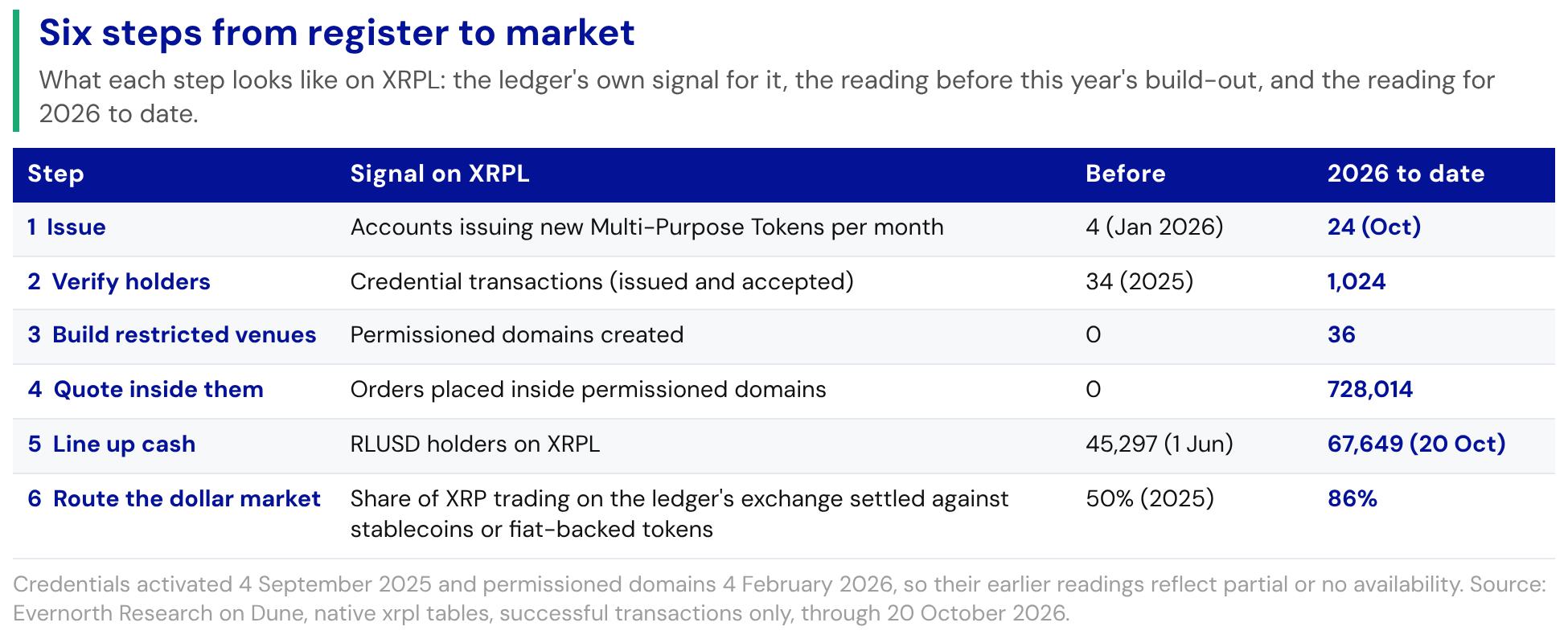
1. The restricted venues are live and carrying orders. Permissioned domains on XRPL, which let an issuer limit a trading venue to credentialed participants, activated in February 20265. Activity is small but growing. Since July the venues have carried a steady stream of orders: 728,014 placed by 23 accounts in 2026. Nearly all of that comes from two accounts that have taken turns quoting inside the venues since July of this year. The participant base is still narrow, but the infrastructure regulated assets needed in order to trade are in daily use.
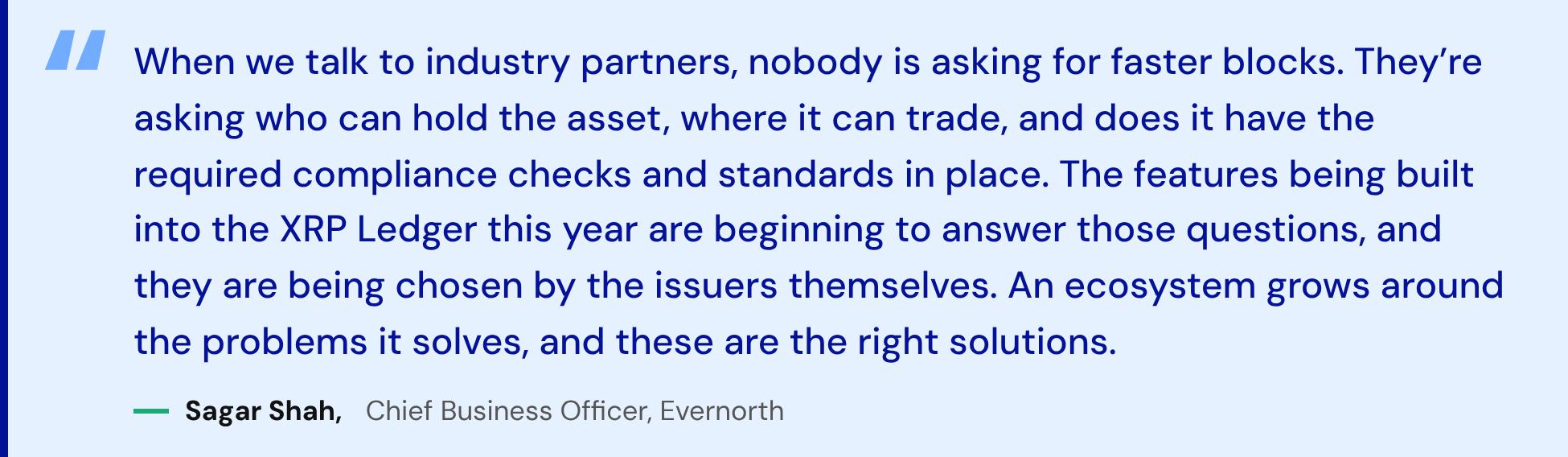
2. The ledger's exchange became a dollar venue. It runs through XRP. Markets build liquidity in dollar pairs. The U.S. dollar sits on one side of about 89%15 of global foreign-exchange trades, and benchmark assets such as gold and oil are priced in dollars. XRPL now has the same structure. In 2024, 10.5% of XRP trading on the ledger’s native decentralized exchange (“DEX”) was against stablecoins or fiat-backed tokens. In 2025 it was 50%. In 2026 to date it is 86%, and 92% of the $1.65 billion of RLUSD swapped on the DEX traded against XRP. The dollar isn’t taking liquidity away from XRP. It trades against XRP.
3. Issuers are choosing regulatory controls at the moment of issuance. Since July, 52% of new Multi-Purpose Token (“MPT”) issuances carried a clawback right, which lets an issuer recover tokens under a legal or regulatory order, up from 23% in the first half of the year; 48% can be held in escrow for conditional settlement, up from 16%. Twenty-six different issuers chose clawback in that period6,8. The compliance layer is part of the design, and it’s being adopted..
1. TOKENIZATION
Issuance is becoming less of an open question. Funds, treasuries, credit, and cash equivalents are on-chain at scale, with 5.3 million holders worldwide1. On XRPL, tokenized value grew from $1.76 billion in February of this year to $5.05 billion as of October 20, which ranks sixth among all networks and fourth among public chains, behind Ethereum, Avalanche, and BNB Chain1,2.
The issuers are increasingly regulated: Aviva Investors launched a tokenized share class of its US Dollar Liquidity Fund on the ledger in July with approval from the Central Bank of Ireland3, and DBS, Franklin Templeton, and Ripple have set out plans to trade a tokenized money market fund against RLUSD and explore its use as loan collateral4.
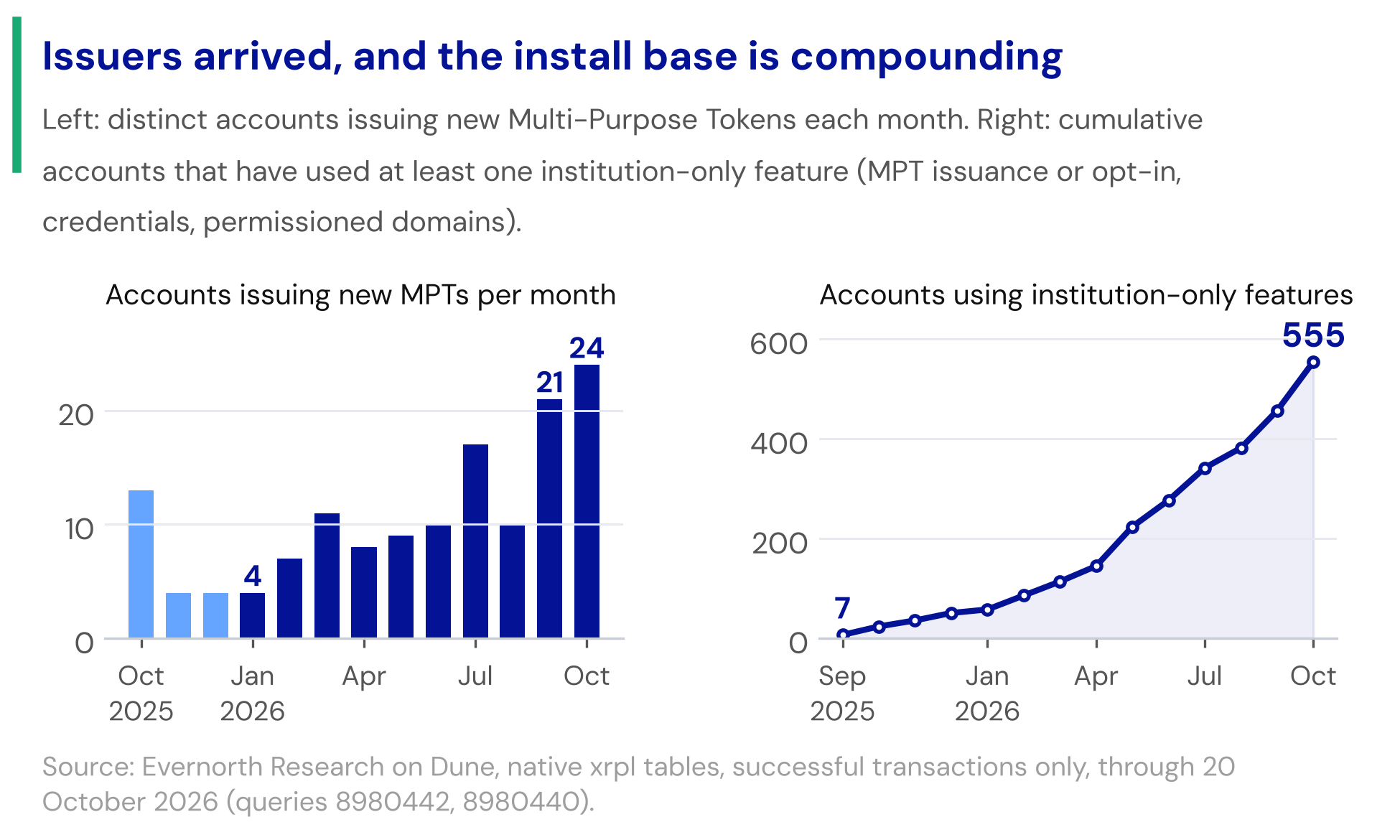
Behind the named funds is a broader shift in who issues. XRPL's Multi-Purpose Token (MPT) standard, live since October 2025, builds issuer controls into the token itself5. In 2026, 460 MPTs were issued, and the number of accounts issuing new tokens each month rose from four in January to 24 in October8. October 2026 added a record 98, and for a fourth consecutive month the growth came from many entities on many days rather than from one program8. RLUSD gives those assets a native cash leg: holders on XRPL rose from 45,297 on June 1 of this year to 67,649 by October 208.
2. DISTRIBUTED TOKENIZATION
The industry separates two kinds of tokenized assets. A represented asset is recorded on-chain while ownership still changes hands off-chain, the way a fund’s transfer agent keeps the register. A distributed asset moves between holders on-chain and can be traded, pledged, or settled directly. Distributed is the goal, because it turns a record into a market. Regulated assets have not historically started there.
A regulated fund can become distributed only once the ledger can verify who holds it, restrict where it trades, and let the issuer meet its legal obligations. Until then, it issues to a few qualified holders and clears transfers off-chain. Assets built for broad retail reach, such as exchange-distributed stocks and yield tokens, skip those steps and are distributed from day one. That is why rankings that count only distributed value favor those chains. XRPL ranks tenth by distributed value and sixth by total value. The difference is about $4.55 billion of institutional assets already on the ledger. A growing number of controls they need to move are being activated. As more primitives come online, more of that $4.55 billion can move. When it does, it can meet cash in RLUSD, and the ledger can route that trade through XRP.
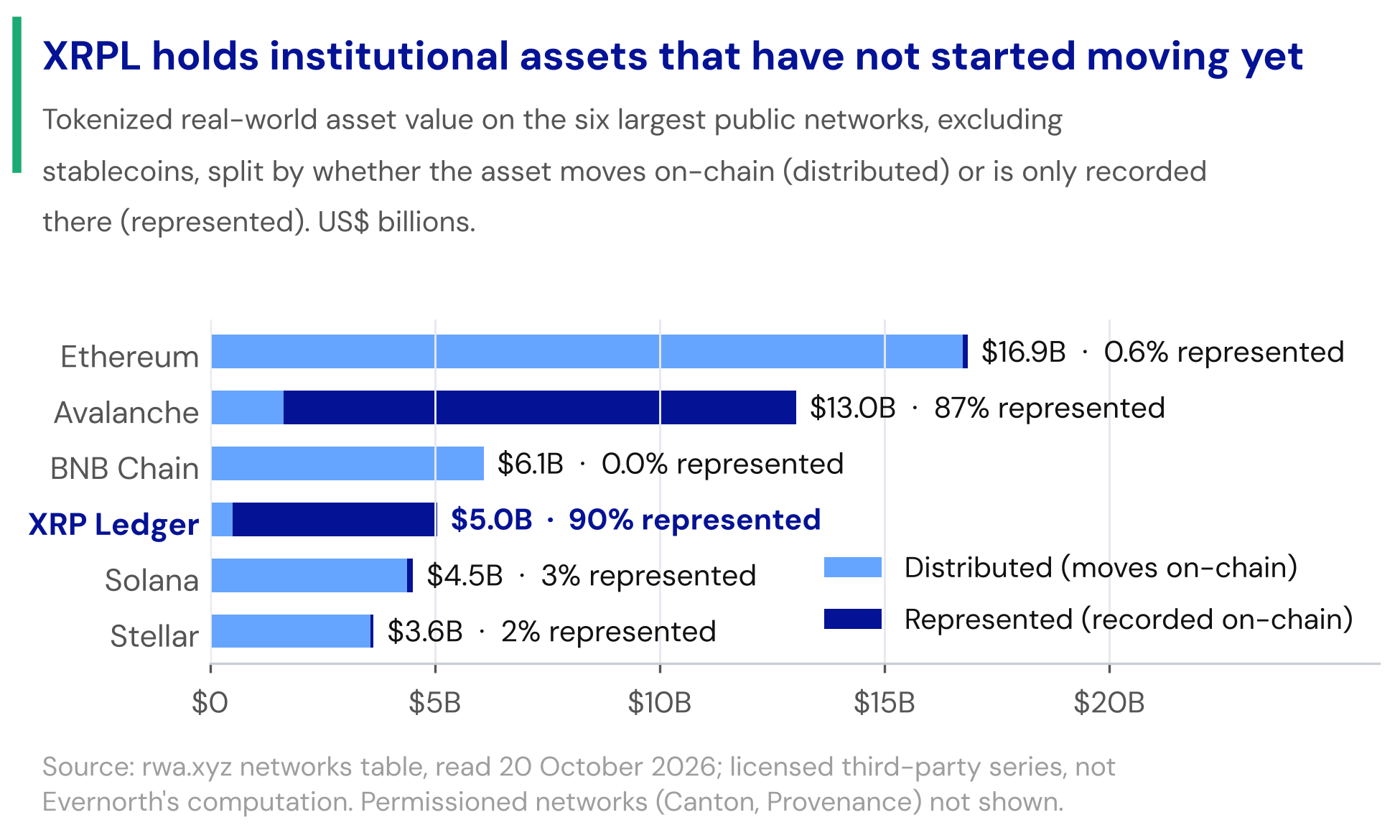
XRPL holds institutional assets that haven’t started moving yet. The chart above shows tokenized real-world asset value on the six largest public chains, excluding stablecoins, split by whether the asset moves on-chain. Ethereum, BNB Chain, Solana, and Stellar are 97% to 100% distributed. XRPL is 90% represented and Avalanche 88%1. On XRPL, 501 of 539 live MPTs have two or fewer holders8, which is consistent with controlled issuance by regulated issuers.
The path from register to market, measured on XRPL. A regulated asset goes from ledger entry to a working market generally when certain conditions are met. An issuer creates the token, then establishes who may hold it. Those holders need a venue closed to everyone else, and the venue needs someone quoting inside it. Trades need cash to settle against, and the cash needs a deep market to price against. The table tracks those conditions. Steps one through four measure the controls, and they have gone from near zero to daily use this year. Steps five and six measure the cash, and they were further along before the controls arrived.
3. PUTTING IT TO WORK
An asset is put to work when it does more than sit idle. It can settle a trade, secure a loan, earn a return, or deepen a market. Each use needs specific infrastructure, and each carries its own risk: credit risk in lending, liquidation risk in collateral, price risk in liquidity pools.
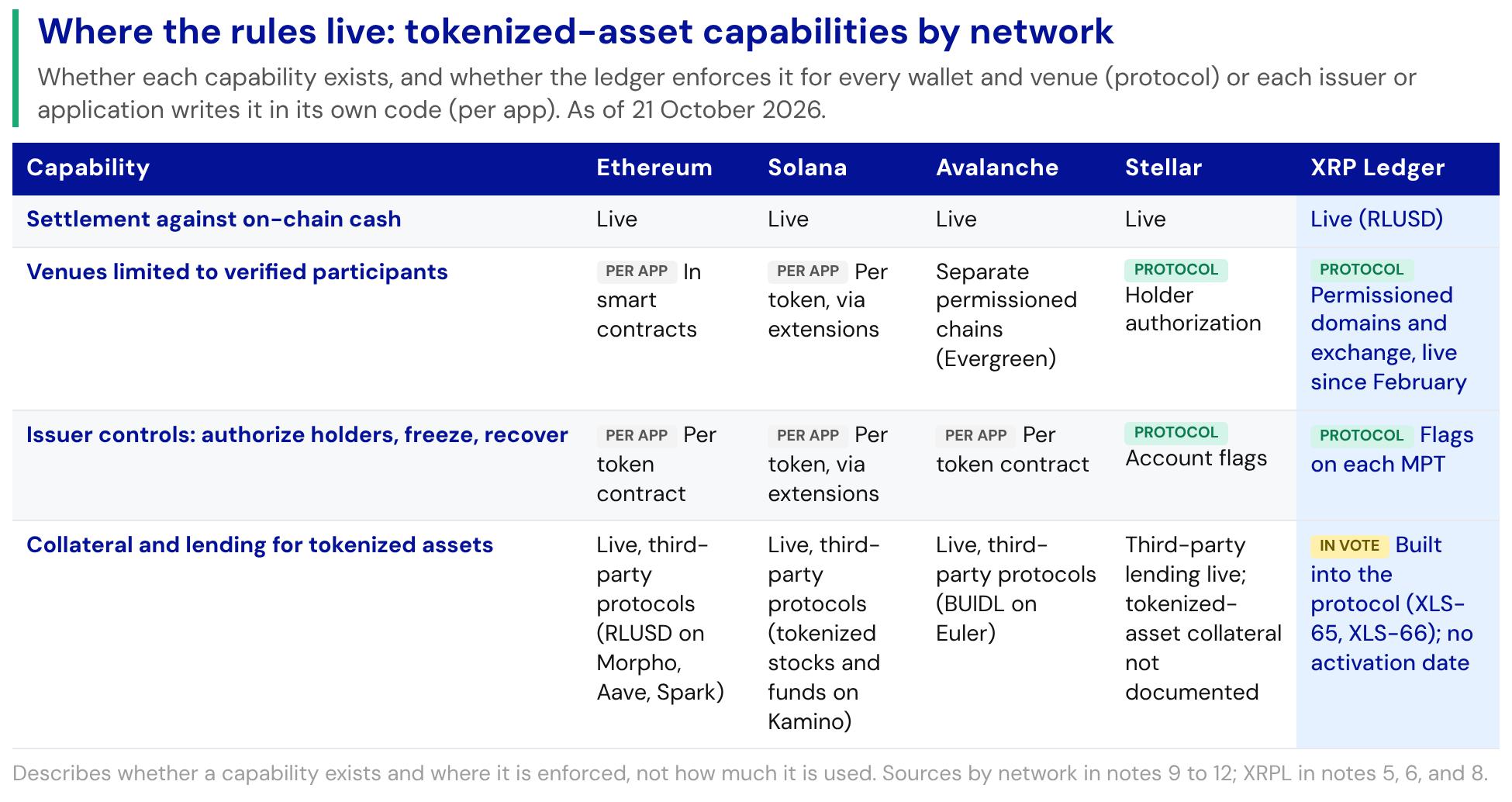
On lending and collateral, Ethereum, Solana, and Avalanche are ahead today: third-party applications on those networks already accept tokenized funds, tokenized stocks, and RLUSD as collateral9,10,11. XRPL's proposed lending protocol is under review by the validators. The difference is where the function lives. On Ethereum, who may hold an asset, where it may trade, and how it may be lent are decided application by application, in code that each issuer or protocol writes and maintains. On Solana and Avalanche, some controls sit at the token or chain level, while lending runs in third-party applications. On XRPL, those rules are part of the ledger itself. An issuer sets them with a flag when the token is created, every venue and wallet enforces them automatically, and a lending function, once activated, runs under the same rules5,6,12. For a regulated issuer that means one rulebook instead of many and fewer counterparties to diligence. The cost is time, because a protocol-level feature arrives only when validators approve it.
The cash arrived first. In 2026, $34.5 billion of RLUSD has moved on XRPL in 11.8 million payments to 64,212 receiving accounts, which is the profile of a settlement rail. A further $1.65 billion was swapped on the ledger's native exchange, 92% of it against XRP8.
The same shift is visible off the ledger. At Uphold, stablecoins such as RLUSD were approximately 17% of destination volume in August 2026, up from a 10% average across 2025, with RLUSD flows growing approximately 1% a month¹³. The dollar is increasingly the cash leg on the ledger and the exchanges that connect it.
A tokenized asset that trades against cash needs a deep dollar market, and on XRPL that market runs through XRP. The ledger has built-in routing. When an asset trades against a dollar stablecoin, the protocol checks the direct order book and also a route through XRP (asset to XRP, then XRP to dollars). It fills the order on whichever route gives the better price. Pathfinding does the same for payments: it searches the available order books and can split one payment across several routes. In practice, XRP liquidity can act as dollar liquidity assets routed through it6.
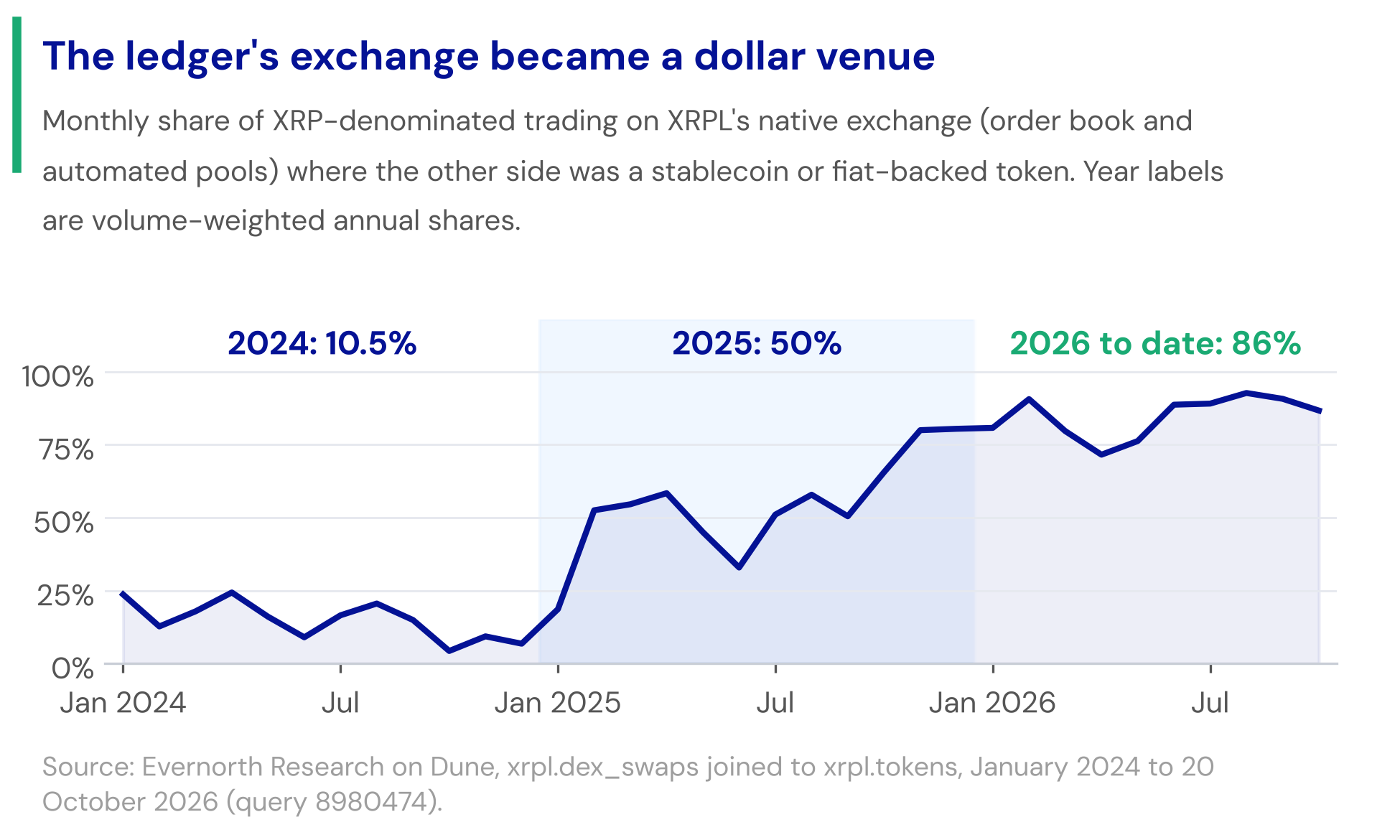
The exchange changed character. The chart above shows monthly share of XRP-denominated trading on XRPL's native exchange, order book and automated pools together, where the other side was a stablecoin or fiat-backed token; annual figures are volume-weighted. The 2024 base was token-for-token trading. By 2026 nearly all of it settles against dollars, which is a precondition for tokenized assets to trade against cash on the same rails8.
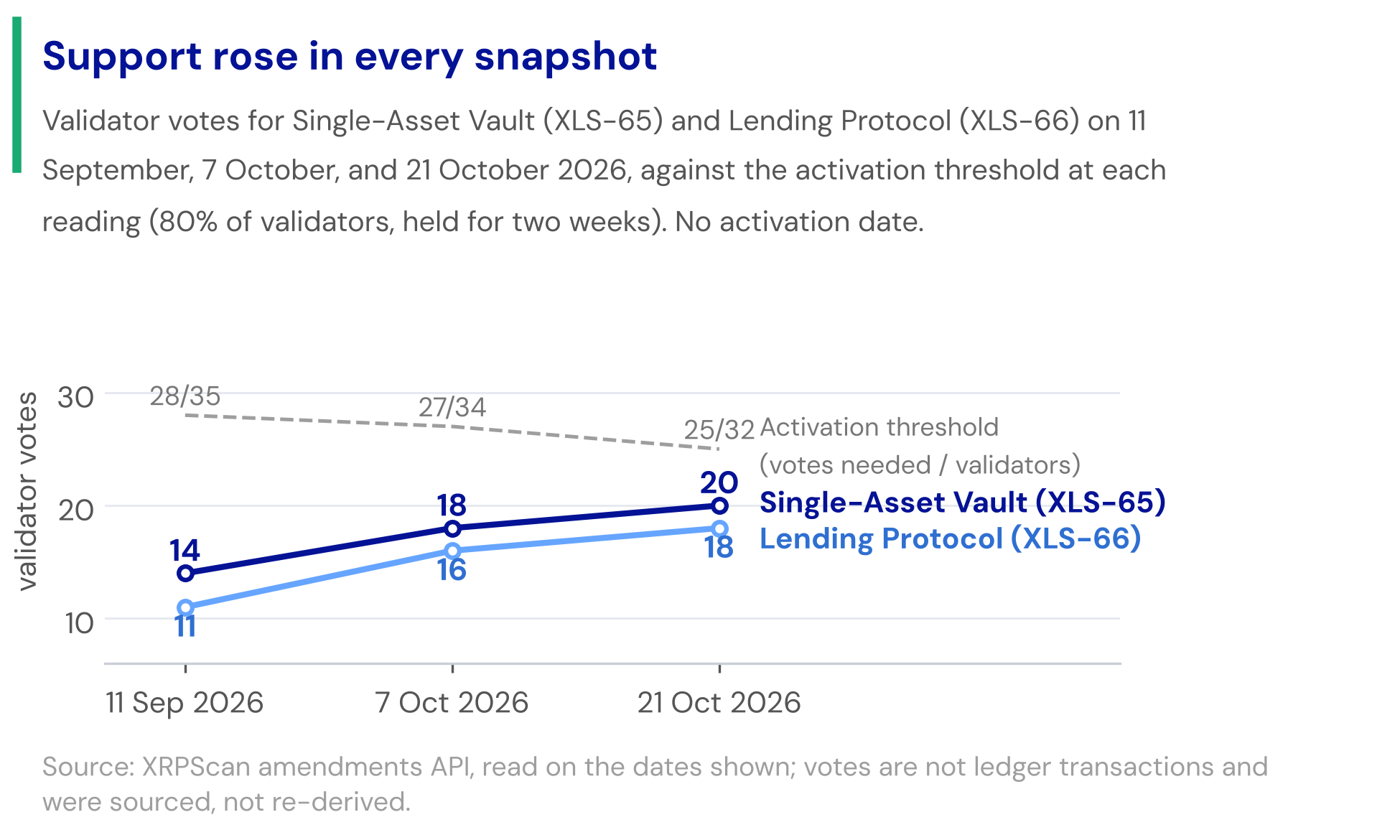
Collateral and lending need two amendments that validators are voting on now: Single-Asset Vault (XLS-65), which pools one asset from many holders, and Lending Protocol (XLS-66), which lends it under set rules while credit decisions stay with the lender. Activation requires more than 80% of validators for two consecutive weeks; a follow-up amendment, LendingProtocolV1_1, must activate first. There is no activation date5. Until then, depth is the open variable. The cash is on the ledger but not yet at work: of 972 million RLUSD on XRPL, 2.6 million (0.27%) sits in the ledger’s automated market maker (AMM) pools8. Vaults and lending would give the rest more ways to work.
4. XRPL'S GROWING ROLE
XRPL is building controls into the base layer rather than bolting it on, and the ledger shows institutions choosing those controls as they issue (takeaway 3). Two further primitives were activated in October 20265. Batch, an institutionally-oriented primitive which bundles several transactions so all succeed or none do, was used by 334 established accounts on October 20, 2026, up from 29 on its first day. Permission Delegation, the second institutionally-oriented primitive which lets an account authorize another to act within limits without sharing keys, was used by 23 accounts in its first two weeks8. Ledger transactions for January to September rose 24% year over year, to 664 million8.
The room to grow is as clear as the progress. XRPL holds 1.3% of global distributed value1, daily order-book participants have been flat at about 1,450, and most RLUSD on the ledger settles payments rather than backing markets8. Those are the gaps vaults, lending, and committed liquidity are designed to close.
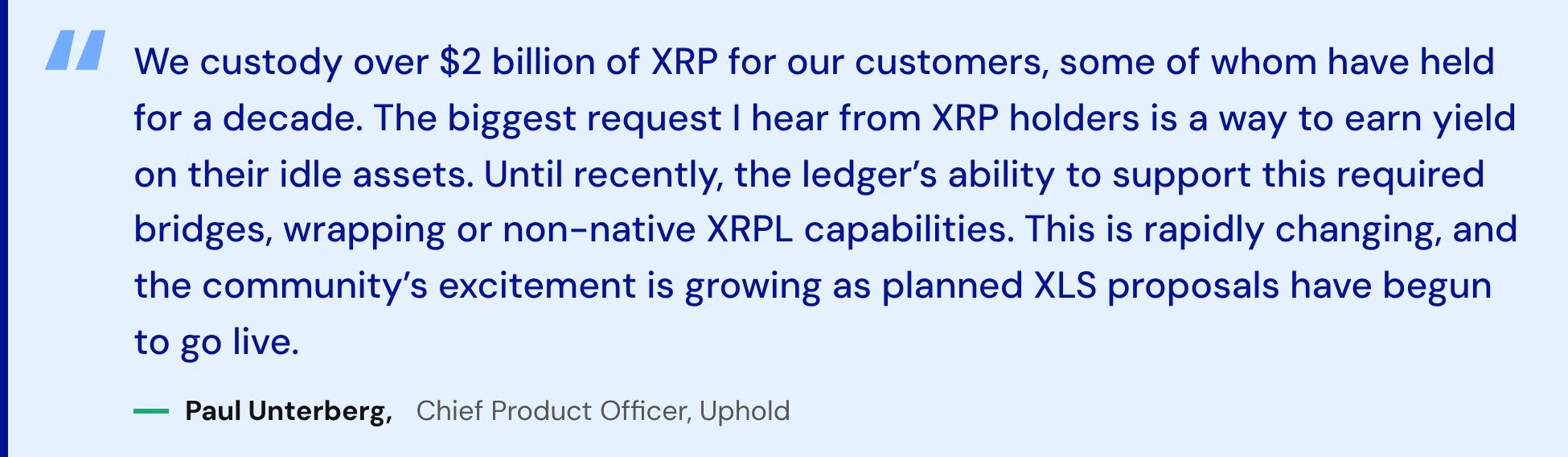
The demand side is already measurable. Uphold data indicates that the ability to earn yield on the XRP Ledger is the most requested feature across all of its customer feedback, with more than 80% of surveyed customers asking for it13. In August 2026, Uphold customers received 18.7% of their staking and yield payouts in XRP, more than in any other asset13. XRP is also the largest digital asset funding source for equity purchases on its platform13.
Borrowing against XRP is also happening on another network. Uphold customers can wrap XRP to Base as cbXRP, where it collateralizes cash loans and a card product through Exactly Protocol13. Assets deposited in that protocol rose from $6.8 million on August 31 to $12.3 million on October 19, with XRP the largest share at $4.3 million to $7.9 million, and $2.2 million has been lent across 2,870 loans since July14.
The pattern in this report is consistent. The controls tend to arrive first, then the cash, then the venues. What none of that supplies is depth, the committed capital that lets an institution trade or borrow in size without moving the market. Evernorth Holdings Inc. (Nasdaq: XRPN) was built to help bridge that gap. It holds approximately 473 million XRP, and intends to put that treasury to work as on-ledger markets develop.⁷ A registry becomes a market when someone is willing to show up early with scale. Evernorth intends to help fill that role.
METHODOLOGY AND DISCLOSURES
On-chain figures are rebuilt by Evernorth Research from Dune's native xrpl tables at the level of individual transactions, swaps, token balances, and pool balances, successful transactions only, 1 January to 20 October 2026 unless stated. "Institution-only features" are MPT issuance and opt-in, credential issuance and acceptance, and permissioned domain creation; an account is counted once, on its first use. "Established accounts" are addresses created before 1 July 2026 holding at least 20 XRP. Issuer-control shares are computed from the flags set on each MPTokenIssuanceCreate transaction, as defined in the XRPL protocol reference. The currency share of trading counts the XRP side of each swap on the ledger's exchange and classifies the other leg by its resolved ticker; trades between two non-XRP assets are excluded. Orders inside permissioned domains are successful OfferCreate transactions carrying a domain identifier; they are orders placed, not trades executed. Real-world asset values and the represented and distributed split are rwa.xyz's published series and exclude stablecoins; they are a licensed third-party series, not our computation. Validator votes are as reported by XRPScan on the dates shown; votes are not ledger transactions and were sourced, not re-derived. The cross-network comparison in section 3 is built from each network's own documentation and from named, dated deployments; it describes whether a capability exists and where it is enforced, not how much it is used. Query IDs are listed in note 8; extracts available on request. This report contains no price data or price expectations.
Forward-looking statements. This report contains statements that are not historical facts, including expectations about market structure, adoption, and network development, and statements about Evernorth's intentions. Such statements are subject to risks and uncertainties, including those described under "Risk Factors" in Evernorth's filings with the SEC, and actual results may differ materially. Evernorth undertakes no obligation to update them except as required by law. This report analyzes the XRP market and tokenized-asset activity on the XRP Ledger. It does not describe Evernorth's financial position, other than its XRP holdings. Evernorth holds XRP and may benefit from increased use or value of XRP and the XRP Ledger. Ripple, Uphold, and Dune have or may in the future have business relationships with Evernorth, This report is not an offer or solicitation to buy or sell any security, and is not investment advice.
NOTES AND SOURCES
1 rwa.xyz, global overview and networks table, read 20–21 October 2026, app.rwa.xyz and app.rwa.xyz/networks. Distributed value $38.95 billion; represented value $362.96 billion; total asset holders 5,271,178. Network totals exclude stablecoins. Canton ($318 billion) and Provenance ($24 billion) are permissioned networks and are excluded from the public-chain comparison. XRPL: $5.05 billion total, $497 million distributed. Stablecoin value $290.39 billion, same source, read 21 October 2026.
2 CryptoSlate, "XRP Ledger surpasses Solana in RWA tokenization value," 11 February 2026, citing rwa.xyz, cryptoslate.com/xrp-ledger-surpasses-solana-in-rwa-tokenization-value. The February figure is $1.756 billion excluding stablecoins; growth to 20 October is 2.88x.
3 Aviva Investors, "Aviva Investors launches tokenised Liquidity Fund share class in partnership with Ripple," 29 July 2026, avivainvestors.com/en-ie/about/company-news/2026/07. Aviva states the share class carries the same investment objective, risk profile, and regulatory protections as the conventional fund.
4 DBS, "DBS and Franklin Templeton to launch trading and lending solutions powered by tokenised money market funds and Ripple's RLUSD stablecoin," 18 September 2025, dbs.com/newsroom. A memorandum of understanding: the sgBENJI listing against RLUSD is planned and the collateral use is described as a later phase DBS will explore; no launch dates are given.
5 XRPScan amendments API, api.xrpscan.com/api/v1/amendments, read 11 September, 7 October, and 21 October 2026. Activation dates: Credentials 4 September 2025; MPTokensV1 1 October 2025; PermissionedDomains 4 February 2026; PermissionedDEX 18 February 2026; fixCleanup3_3_0 11 September 2026; PermissionDelegationV1_1 8 October 2026; BatchV1_1 and fixBatchV1_2 9 October 2026. On 21 October SingleAssetVault had 20 votes, LendingProtocol 18, and LendingProtocolV1_1 18, against a threshold of 25 with 32 validators reporting.
6 XRP Ledger protocol reference, MPTokenIssuanceCreate, xrpl.org/docs/references/protocol/transactions/types/mptokenissuancecreate. Flags: tfMPTCanClawback lets the issuer reclaim value from holders; tfMPTCanEscrow lets holders place balances into escrow; tfMPTRequireAuth requires each holder to be authorized before holding the token. Routing: XRPL documentation on auto-bridging (xrpl.org/docs/concepts/tokens/decentralized-exchange/autobridging) and payment paths (xrpl.org/docs/concepts/tokens/fungible-tokens/paths).
7 Evernorth Holdings Inc., "Evernorth to begin deploying from 473 million XRP treasury with Ripple, Kraken, Coinbase and BitGo," 14 October 2026, globenewswire.com. Partner agreements are subject to customary closing conditions and approvals.
8 Evernorth Research on Dune, public query IDs: 8980442 (MPT issuances and flags), 8980427 (credentials and domains), 8980433 (orders inside domains), 8980458 (issuer and sender attribution; ledger transactions), 8980440 (institution-only feature users), 8980474 (currency share of trading), 8980451 (RLUSD flow and holders), 8980478 (RLUSD in pools), 8980452 (live MPTs), 8980337 (Batch users). Order-book participants per day are Evernorth's standing series, about 1,450 across September and October 2026.
9 Ethereum: DefiLlama, RLUSD token page, defillama.com/token/rlusd, read 21 October 2026, listing RLUSD markets on Morpho Blue (Sentora RLUSD vaults), Aave V3 (including the Aave Horizon RWA market), and SparkLend. Pool figures are total pool value, not RLUSD-only balances. Venue and issuer controls on Ethereum are implemented in each token's or application's smart contract.
10 Solana: Solana Foundation, Token Extensions guide, solana.com/developers/guides/token-extensions/getting-started (transfer hooks, permanent delegate, default account state, confidential transfers, configured per token at creation). Lending: Token Terminal data reported by The Defiant, 17 July 2026, and Solana Compass, 18 July 2026: $23.1 million of tokenized-stock lending across DeFi with Solana at 85.5%, Kamino Finance at 82.6% of venue share, and Superstate tokenized funds at $17 million of active collateral on Kamino.
11 Avalanche: Ava Labs, "Avalanche launches Evergreen for institutional blockchain deployments," 9 April 2023, avalanche.com/about/blog ("private, permissioned chains with known and approved counterparties"). Collateral: The Block, "BlackRock's sBUIDL launches first direct DeFi protocol integration with Euler on Avalanche," 15 May 2025; sBUIDL is Securitize's token redeemable for BUIDL.
12 Stellar: Stellar Development Foundation, "Control access to an asset," developers.stellar.org/docs/tokens/control-asset-access (Authorization Required, Authorization Revocable, and Clawback Enabled flags set on the issuing account and enforced by the ledger). Lending: SDF, "Composability on Stellar: from concept to reality," stellar.org/blog, describing Blend as a decentralized lending protocol with integrations live on Mainnet; we found no documented use of tokenized real-world assets as collateral there as of 21 October 2026.
¹³ Uphold, platform data provided to Evernorth, October 2026: stablecoin share of destination volume (about 17% in August 2026 against a 10% average in 2025); XRP share of staking reward and yield payouts (18.7% in August 2026, across the assets Uphold supports); XRP as the largest crypto funding source for equity purchases on Uphold; customer survey on yield on XRP (over 80% of respondents); XRP wrapped to Base as cbXRP for loans and a card product. Uphold's own figures for that activity were $6.43 million (August), $13.41 million (October), and $2.19 million borrowed; the text uses the on-chain series in note 14, and the differences reflect snapshot dates. These are Uphold’s internal platform figures, reported as provided and not independently verified by Evernorth.
14 Exactly Protocol (Base) dashboard on Dune, dune.com/exactly/exactly-base, read 23 October 2026, from the protocol's materialized views (dune.exactly.result_user_account_balance, refreshed weekly, and dune.exactly.result_exa_loans_op_base): deposits across all assets $6.85 million on 31 August and $12.26 million on 19 October 2026, of which XRP $4.27 million and $7.87 million; loans since 1 July 2026, 2,870 totalling $2.22 million. Evernorth re-ran the queries (Dune query 8999594).
15 Bank for International Settlements, Triennial Central Bank Survey, OTC foreign exchange turnover in April 2025, bis.org/statistics/rpfx25_fx.htm: the US dollar was on one side of 89.2% of all trades in April 2025; daily turnover $9.6 trillion.