WHY WE PUBLISH THIS REPORT
Tokenized assets and liquidity are the building blocks of the next financial system. As real-world value moves on-chain, the networks that attract the deepest, most persistent liquidity are the ones worth tracking. Every quarter this report tracks the same six measures of where that liquidity forms and moves across XRP, four of them computed from the ledger itself.
Trades got bigger. Balances got deeper.
Q2 2026 activity on the XRP Ledger was defined by shifting trading behavior and deepening liquidity on the heels of more useful infrastructure.
- A portion of a tokenized US Treasury fund was redeemed, with the asset leg settling on-ledger in under five seconds1.
- The sidechain that runs Ethereum-style smart contracts for XRP moved onto actively maintained software2.
- A protocol amendment hardened permissioned domains and multi-purpose tokens3.
- RLUSD went multichain4.
Capital and regulation followed a similar line. US spot XRP ETFs took in $273 million across the quarter, with net inflows in all three months5. An OCC rule effective April 1 affirmed that national trust banks may engage in non-fiduciary activities including custody, without addressing digital assets specifically6. In addition, the CLARITY Act advanced out of the Senate Banking Committee on May 147.
The flow data moved in step. Trading on the ledger’s decentralized exchange (DEX) ran at 4.42 million XRP per day, up approximately 20% year over year, and the value held on the network averaged $4.26 billion across the quarter. Activity concentrated as it grew: approximately 2,435 accounts traded daily, with fewer moving more XRP than the previous year.
Underneath the headlines, the ledger’s own data is more specific about how the quarter’s activity was distributed. Three findings stand out.
THREE KEY TAKEAWAYS
1. Nearly 3x the trading volume per account on the XRPL DEX order book. Order-book trading reached 3.57 million XRP per day, 79% above a year earlier. At the same time, the number of accounts initiating those trades went from 1,864 to 1,111 per day. That works out to 3,217 XRP bought or sold per account each day, against 1,072 a year earlier. The order book accounted for 81% of trading activity on the DEX in the quarter, up from 54% a year ago. Sequentially, total trading was 16% below Q1 2026, a quarter that included an unusually heavy February. More volume passing through fewer accounts is a pattern one would expect as professional flow takes a larger share of activity. The network’s institution-facing infrastructure arrived alongside it, with permissioned domains and permissioned trading venues activating in February3.
2. RLUSD grew faster on XRPL. RLUSD balances averaged $539 million, up from $73 million a year earlier, without a single down quarter. In spite of stablecoin supply across the industry contracting for the first time since 20238, supply grew 642% over the year, and the value moved grew 925%. This lifted XRPL’s overall share of RLUSD from 20% to 34%. Deeper stablecoin balances raise the size of the payments and tokenized-asset transactions the ledger can settle.
3. XRPL account growth declined as sector-wide trading nearly halved. Accounts transacting on XRPL averaged 16,587 a day and new accounts 2,783, both down approximately 25% from the prior year period. Activity across blockchain networks contracted over the same period: on-chain exchange volume fell 46% year over year, and transaction fees paid across the seven largest programmable networks fell 38%. Account counts are the most retail-sensitive measure we publish, and retail stepped back across the whole market in the quarter.
THE SCORECARD
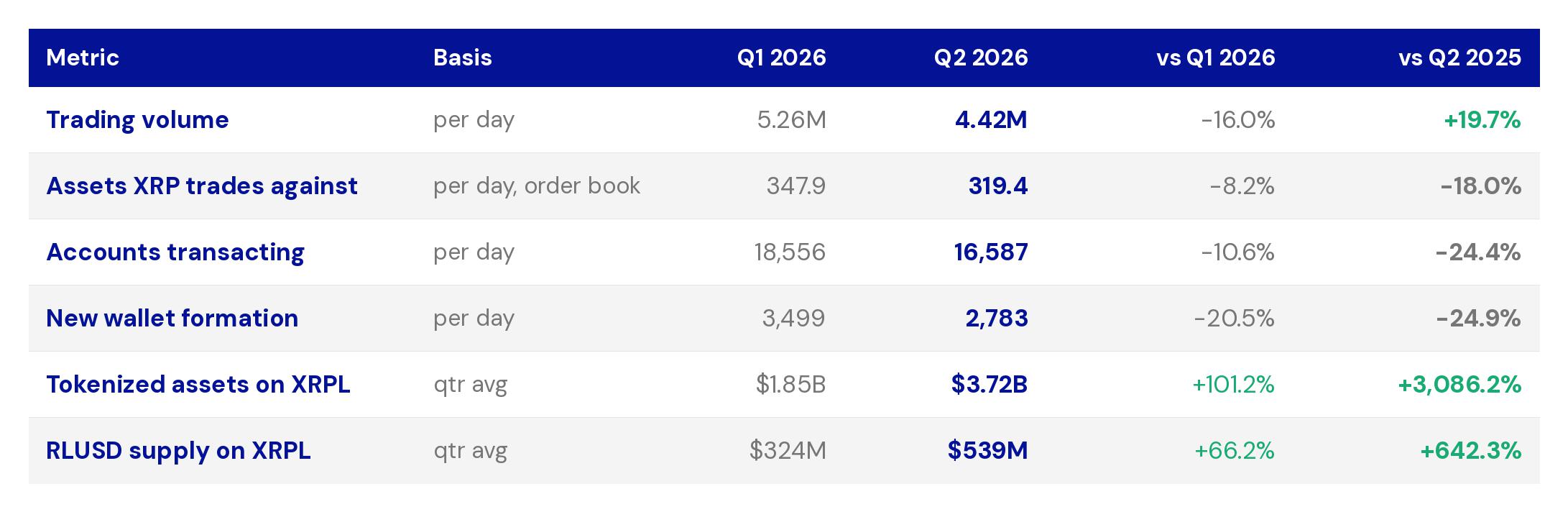
Trading volume is all trading against XRP on the ledger’s exchange, the order book and the automated pools together; takeaway 1 above reports the order-book component separately.
THE TRENDS
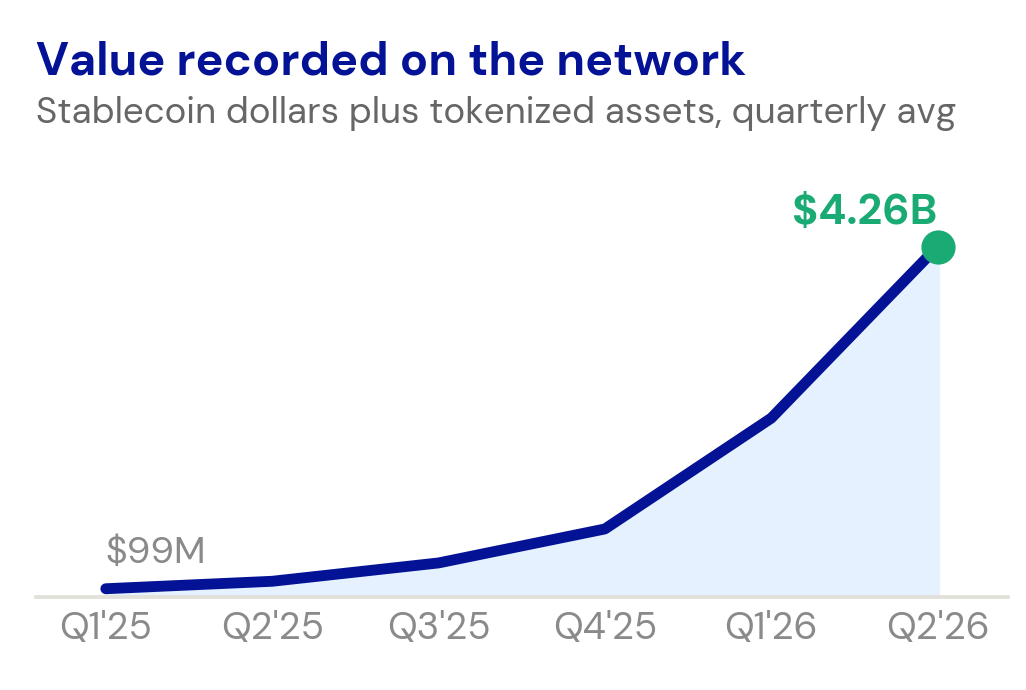
Value on the network compounded. $99M to $4.26B across six quarters, higher in every step and no quarter down, with Q2 the series high. The direction has held for a year and a half.
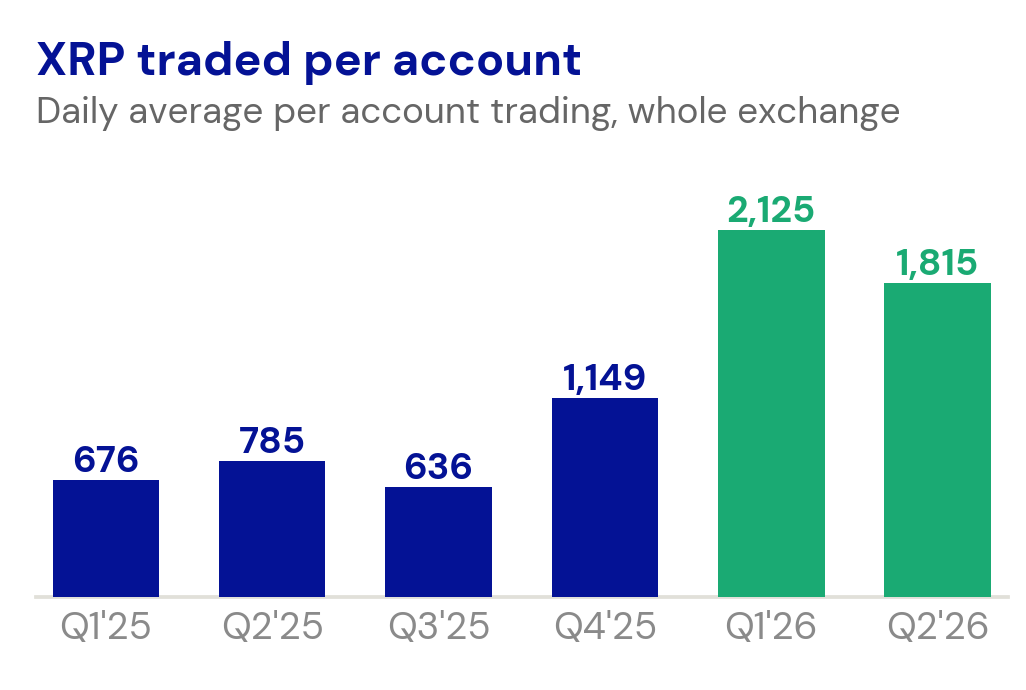
Volume per account is on a different path to account count. XRP traded per account across the whole exchange rose 81% into Q4 2025 and 85% again into Q1 2026. Q2 gave back 15% of that and still sits at 2.7 times where the series began.
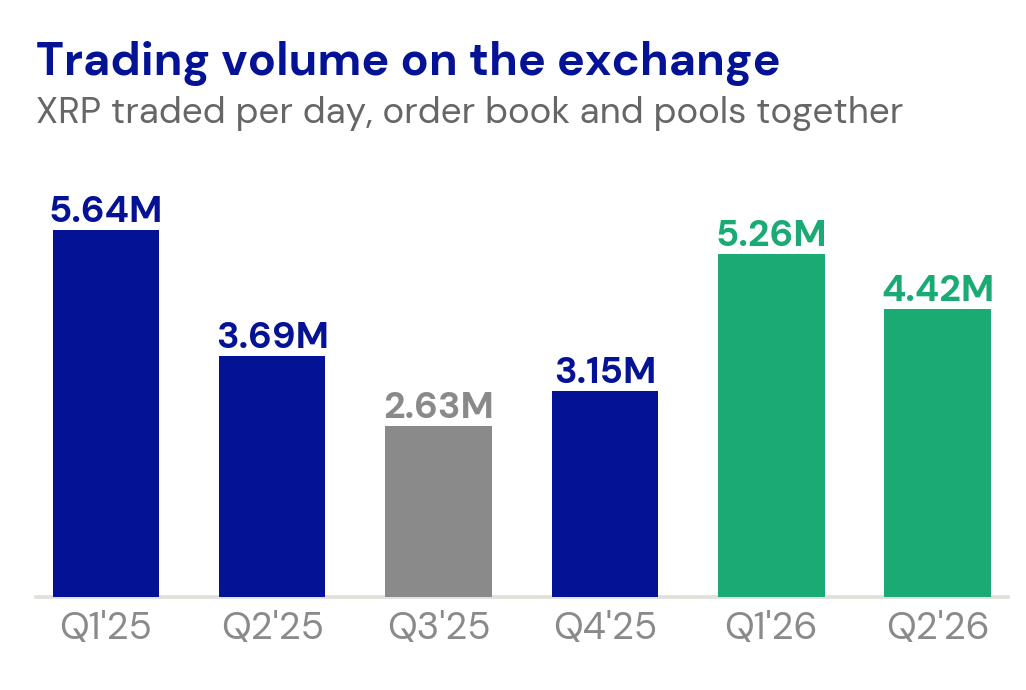
Trading volume recovered from its 2025 low. Volume fell to a Q3 2025 trough and recovered through Q1 2026, giving back part of it in Q2. Q2 still ran 68% above that trough and above every quarter of 2025 except the first, which remains the series high.
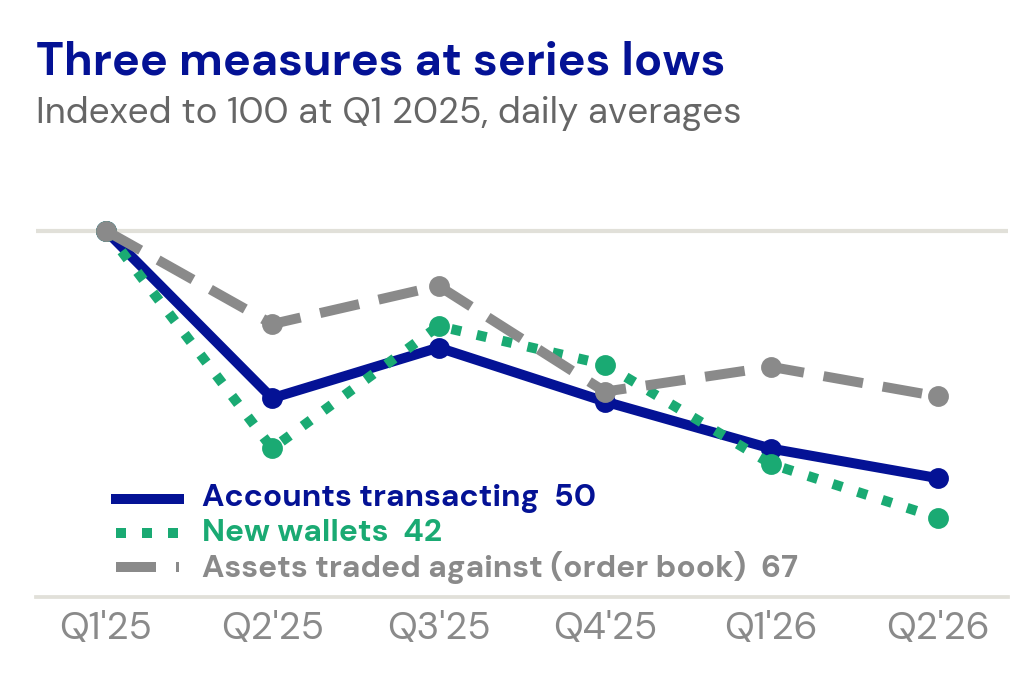
Three measures ended the quarter at series lows. Accounts transacting fell from 33,145 to 16,587 a day, new wallets from 6,617 to 2,783, and the assets XRP trades against on the order book from 479.9 to 319.4. Measured quarter-end over the same six quarters, XRP-paired pools grew 26% while trading through those pools fell 74%, so the pool count is capacity.
WHAT SHIPPED IN Q2
20 May The XRPL EVM sidechain, the companion chain that runs Ethereum-style smart contracts for XRP, announced v9.0.0. It migrated off unmaintained Evmos software onto actively maintained Cosmos EVM and added current Ethereum standards, lowering the cost of building on it.2
27 May The fixCleanup3_1_3 amendment activated on the ledger during the quarter. It hardened multi-purpose tokens and permissioned domains, both live on the network since February, along with the vault and lending code, which validators are assessing.3
4 June RLUSD went multichain through Wormhole’s Native Token Transfers standard, moving natively rather than as a wrapped asset across Base, Optimism, Ink, Unichain and the XRPL EVM sidechain, alongside the XRP Ledger and Ethereum.4
METHODOLOGY AND DISCLOSURES
Three of the six scorecard measures — trading volume, accounts transacting and new wallet formation — are rebuilt by Evernorth Research from Dune’s native xrpl tables at the level of individual swaps and transactions. Assets XRP trades against is Dune’s daily order-book pair count taken as published. RLUSD supply comes from a daily balance extract and tokenized assets from rwa.xyz’s daily series, excluding stablecoins so RLUSD is not counted twice; those two are licensed third-party series, not our computation. Trading volume counts the XRP side of each swap on the ledger’s exchange, once per trade and gross of direction, so it measures turnover rather than accumulation. Trades between two non-XRP assets are excluded; they were 18% of trades and roughly 9% of value in the quarter. An account is one ledger address that submitted a transaction, counted daily and then averaged; every count is of the address initiating activity, not the counterparty, so accounts providing resting liquidity are not counted. “Accounts transacting” counts any transaction type; “accounts trading” counts exchange trades only, and the two are not interchangeable. Value transferred for RLUSD is gross transfer volume over the quarter — on XRP, payments delivering RLUSD plus swaps with an RLUSD leg. The seven programmable networks are Ethereum, BNB Chain, Base, Arbitrum, Polygon, Optimism and Avalanche, the seven largest by fees paid in Q2 2025. Cross-network figures are denominated in US dollars because no other unit is common across chains, while XRP’s own measures are denominated in XRP; the two are not directly comparable. Query IDs and extracts available on request.
Forward-looking statements. This report contains statements that are not historical facts, including expectations about market structure, adoption and network development. Such statements are subject to risks and uncertainties, including those described in the registration statement and proxy materials filed with the SEC in connection with the proposed business combination, and actual results may differ materially. This report analyzes the XRP market. It does not describe Evernorth’s financial position, is not an offer or solicitation to buy or sell any security, and is not investment advice.
NOTES AND SOURCES
1 Ondo Finance, “Ripple, JPMorgan and Mastercard complete first cross-border tokenized Treasury redemption,” 6 May 2026, ondo.finance/blog/ondo-jpmorgan-mastercard-ripple-tokenization; CoinDesk, 7 May 2026. Ripple redeemed a portion of its OUSG holdings; Ondo processed the redemption. Ondo reports the asset leg settling on-ledger in under five seconds — an issuer statement covering one leg of the transaction, not end-to-end bank settlement.
2 XRPL EVM Core Team / Peersyst, “Migration from Evmos to Cosmos EVM,” 20 May 2026, xrplevm.org/blog/migration-evmos-to-cosmos-evm. Release announcement; two of the added Ethereum standards (EIP-3651, EIP-6780) are noted as partially supported.
3 XRP Ledger Foundation, “Introducing XRP Ledger version 3.1.3,” xrpl.org/blog/2026/rippled-3.1.3, which enumerates the fixes to permissioned domains, multi-purpose tokens, vaults and the lending protocol. Activation confirmed on-ledger: EnableAmendment pseudo-transaction, ledger 104,507,137, 27 May 2026 03:51 UTC. Permissioned domains activated 4 February 2026 and the permissioned DEX 18 February 2026, both before Q2 2026. The Single Asset Vault (XLS-65) and Lending Protocol (XLS-66) amendments were in validator voting at quarter end and had not activated; this amendment corrected their code, not their status.
4 Wormhole, 4 June 2026. RLUSD moves natively, without wrapped assets, via the Native Token Transfers standard.
5 SoSoValue, Total XRP Spot ETF History, daily net flows aggregated by month: $81.59M in April 2026, $131.94M in May 2026 and $59.46M in June 2026, $273.00M for the quarter across 62 trading days, with no month in net outflow.
6 Office of the Comptroller of the Currency, final rule amending 12 CFR 5.20, Federal Register 2 March 2026, effective 1 April 2026; OCC Bulletin 2026-4. The rule affirms that national trust banks may engage in non-fiduciary activities including custody and safekeeping. It does not address digital assets specifically, and the OCC declined to confirm that a national trust bank need conduct no fiduciary activities at all.
7 US Senate Committee on Banking, Housing, and Urban Affairs, 14 May 2026; the Digital Asset Market Clarity Act advanced on a 15–9 vote.
8 CoinGecko, 2026 Q2 Crypto Industry Report. Aggregate stablecoin market capitalization declined in Q2 2026, the first quarterly contraction since Q3 2023. Evernorth has not reproduced this series from chain data; it is cited as published.