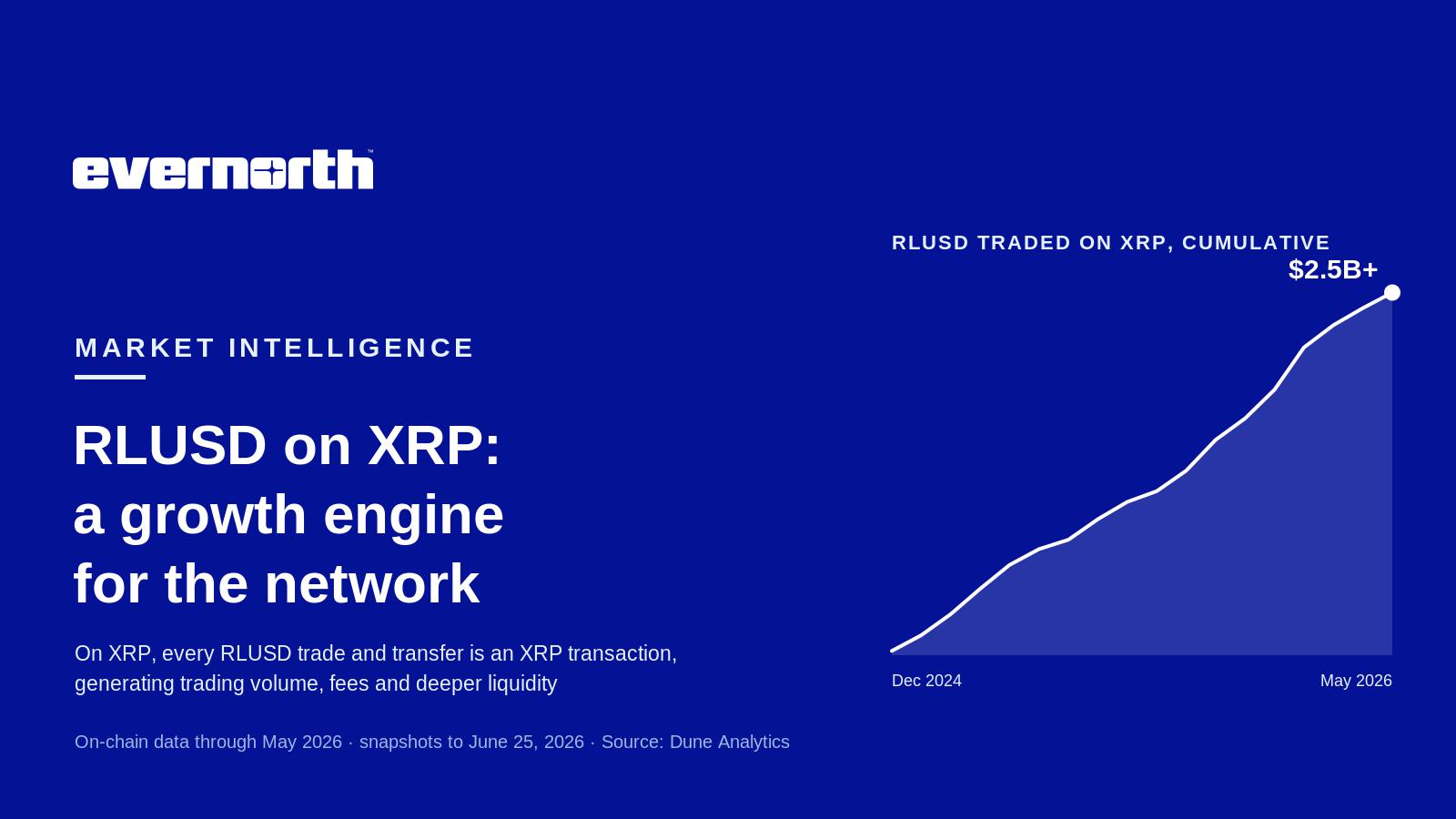
RLUSD on XRP: a growth engine for the network?
On XRP, every RLUSD trade and transfer is an XRP transaction, generating trading volume, fees and deeper liquidity
A question has been coming up in the blockchain community: as RLUSD grows on XRP, does a dollar stablecoin start to replace XRP itself? The on-chain data in this report points the other way. RLUSD isn’t substituting for XRP; it’s running on it. Every RLUSD trade and swap settles on XRP and pairs primarily against XRP, so as RLUSD has scaled it has deepened XRP liquidity, added to the network’s trading activity, and generated more XRP in fees.
The two assets do different jobs. RLUSD is the dollar; XRP is the neutral, issuer-less asset that most trades route through. We recently laid out why in our Swap Kid explainer. The report that follows shows what that looks like in the data.
Headline numbers
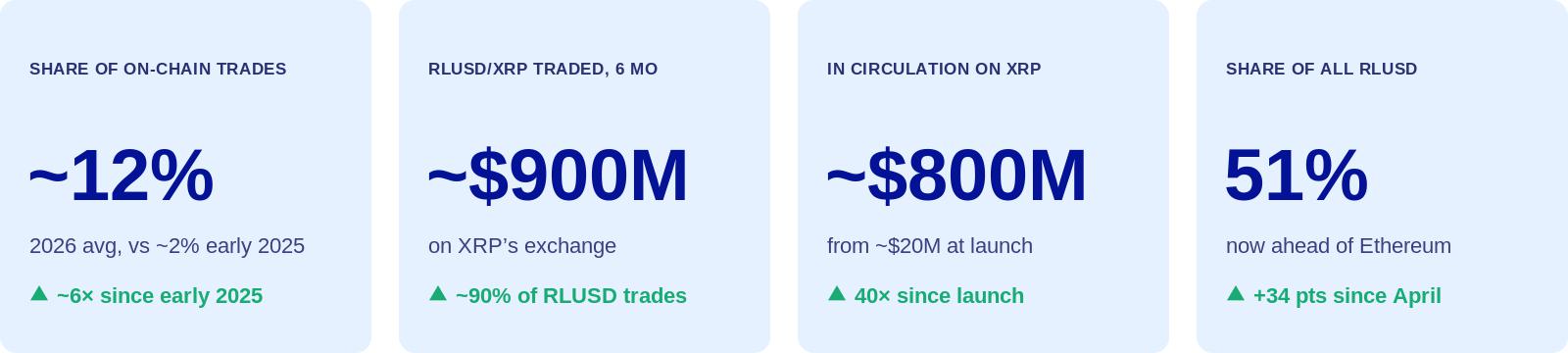
- RLUSD is now one of the most-traded issued assets on XRP. Its share of all on-chain trading climbed from under 1% to about 12% in 2026, and the RLUSD/XRP pair alone has cleared roughly $900 million over the last six months.
- On XRP, that activity is XRP activity: RLUSD trading accounts for approximately a million transactions a month and burns XRP in fees with every trade, feeding the network’s own economy.
- It has built a deep dollar market. More than $2.5 billion has traded through RLUSD pairs on XRP since launch, a dollar-denominated venue that did not meaningfully exist eighteen months ago.
- And it has overtaken Ethereum: a slight majority — about 51% — of all RLUSD in circulation now sits on XRP, up from about 17% in April 2026.
1. RLUSD is the most-traded issued asset on XRP
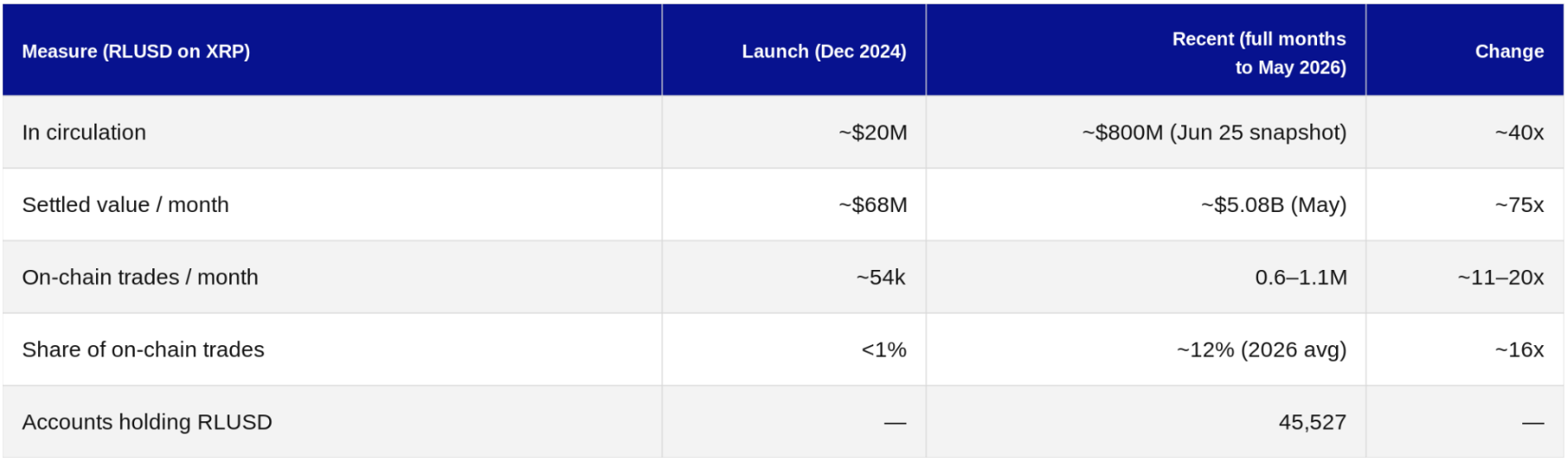
XRP has a built-in exchange where users trade assets directly on the network — both through a traditional order book and through automated liquidity pools (often called an AMM, where trades execute against a shared pool of funds rather than a specific buyer or seller). On that exchange, RLUSD has gone from a curiosity to one of the most-traded assets. RLUSD-paired trade transactions grew from roughly 54,000 in December 2024 to roughly 0.6–1.1 million a month, and RLUSD’s share of all on-chain trades on XRP climbed from under 1% to about 12% across 2026.
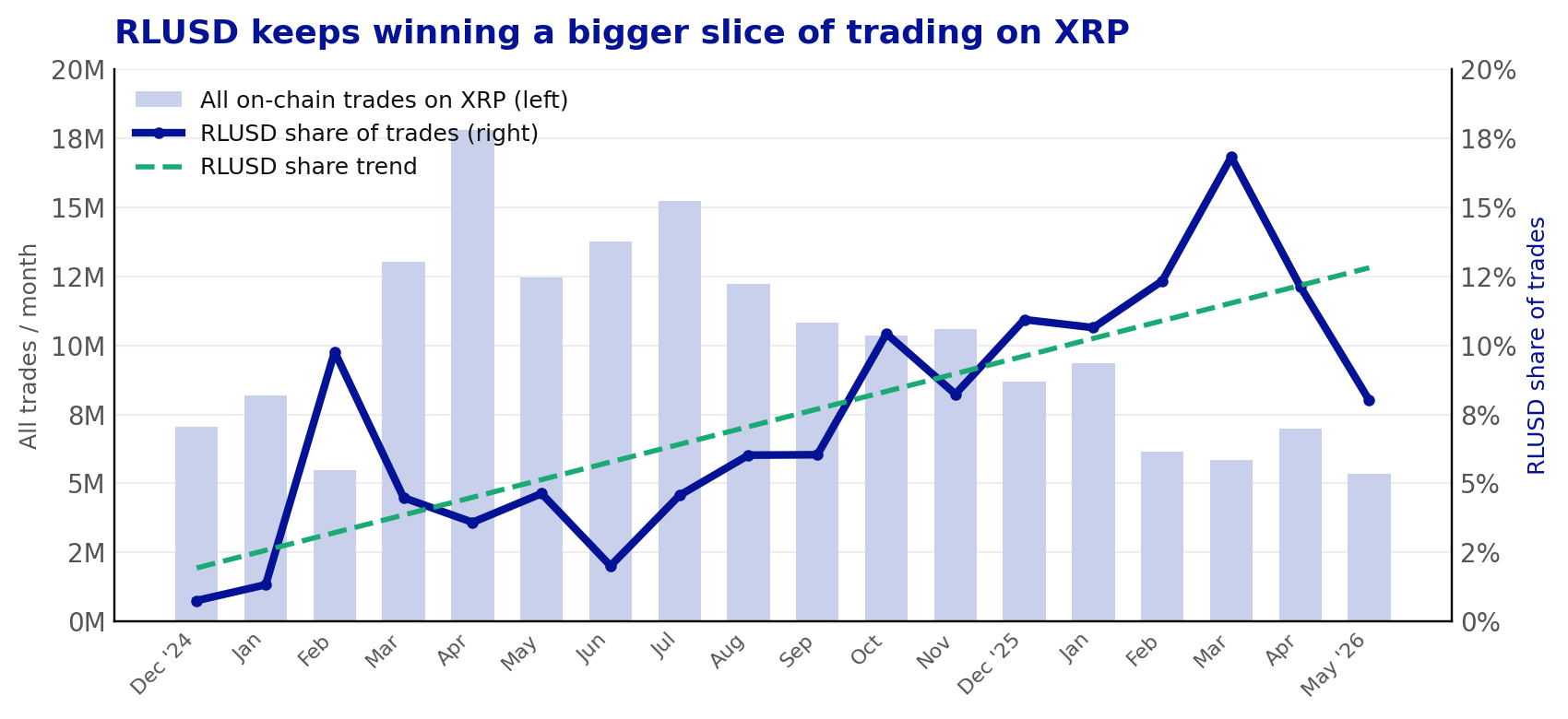
Bars: all on-chain trades on XRP per month (each trade counted as one transaction). Line: RLUSD’s share of those trades, with trend. Full months through May 2026. Source: Dune Analytics (xrpl.dex_swaps).
Total trading on XRP’s DEX did cool over this period, so RLUSD’s rising share reflects it capturing a larger slice of activity versus single-handedly growing the whole market. Either way, the direction is that when people trade on XRP, they are increasingly trading the dollar.
2. USD powers global markets
Growth in RLUSD activity on the XRP Ledger matters because of how markets are built. In traditional finance, the U.S. dollar is the near-universal trading currency: it sits on one side of roughly 88% of all global foreign-exchange trades (BIS, April 2022), and the world’s benchmark prices for gold and oil are quoted in dollars. Liquidity concentrates in dollar pairs because routing through a deep dollar market is the cheapest, fastest way to move between any two assets.
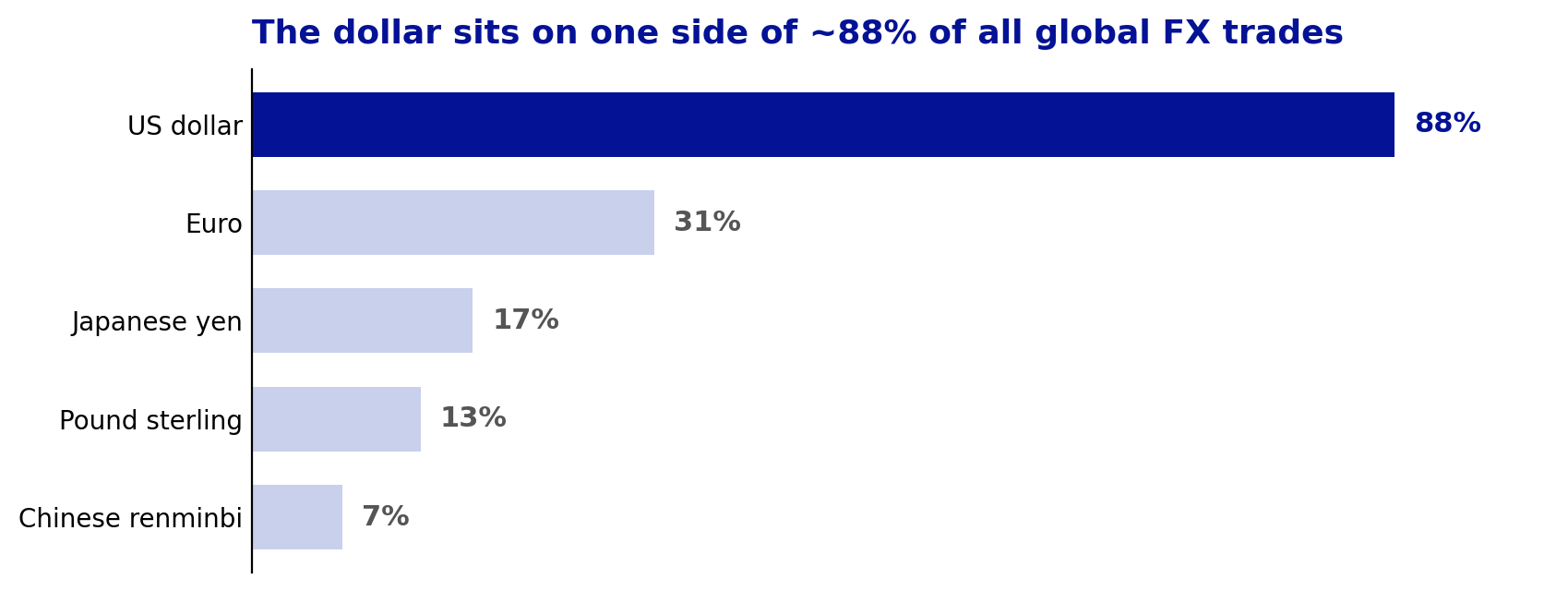
Share of global foreign-exchange trades with each currency on one side (totals to ~200%, since every trade has two currencies). Source: BIS Triennial Central Bank Survey, April 2022.
RLUSD/XRP is the on-chain version of that same pattern, and it has gone from nothing to clearing almost a billion dollars: roughly $900 million over the last six months — close to 90% of all RLUSD trading on the network — with smaller pairs against other dollar, euro and currency tokens making up the rest. XRP now has a deep, dollar-denominated trading pair that did not meaningfully exist eighteen months ago.
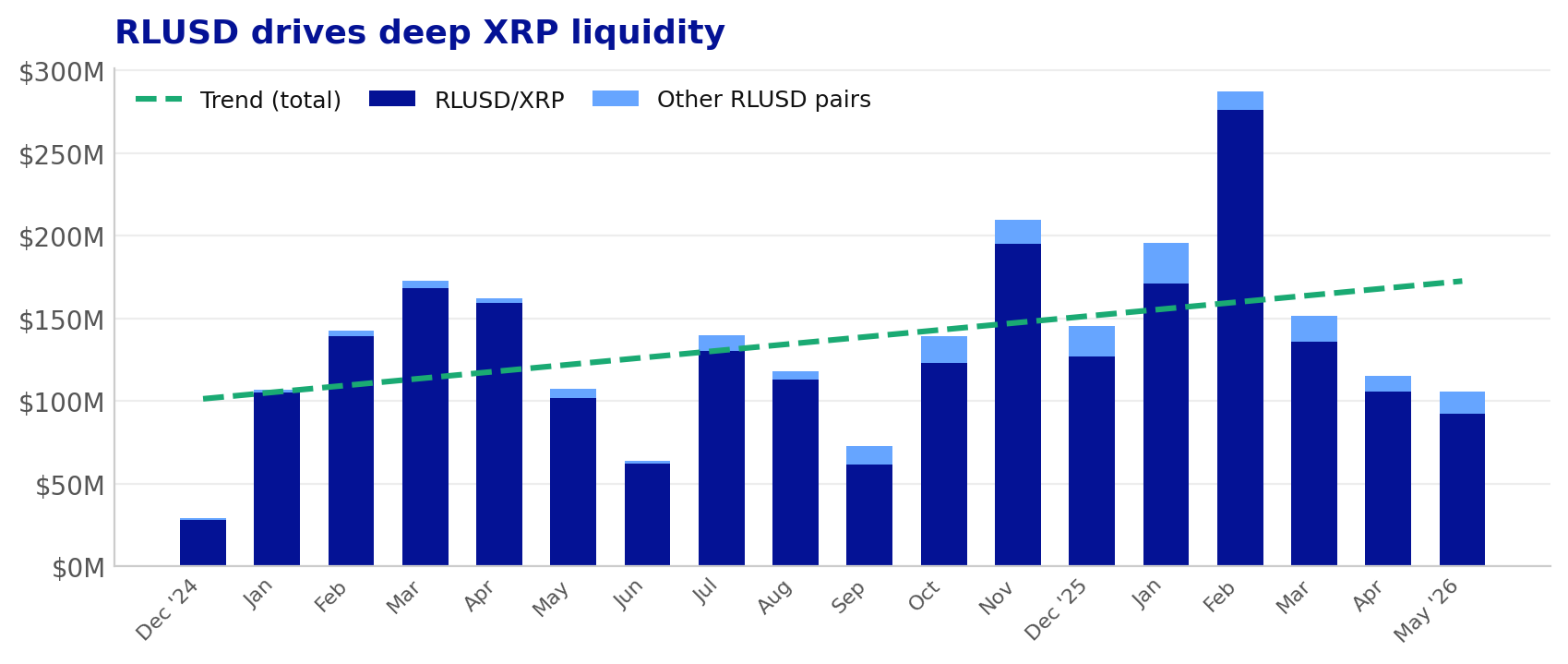
RLUSD traded value on XRP, per month (RLUSD side of each trade; ≈90% is the RLUSD/XRP pair). Full months through May 2026. Source: Dune Analytics (xrpl.dex_swaps).
3. RLUSD contributes to XRP’s on-chain economy
All of this is real economic throughput. Cumulatively, more than $2.5 billion in trading value has routed through RLUSD pairs on XRP’s exchange since launch, and RLUSD trading now accounts for on the order of a million of XRP’s transactions a month in trading alone, separate from its direct transfers. RLUSD has become a core quote and liquidity asset that XRP and other tokens trade against.
RLUSD trading feeds economic activity on XRP as measured by XRP fee burn
Every trade pays a fee in XRP, so the tokens that trade most also burn the most XRP. RLUSD has risen into the top-tier of that token-level burn amongst all issued tokens on the network (XRP aside). It led every month from October 2025 through April 2026 within a volatile field where speculative tokens occasionally spike higher. Because every trade settles on-chain and pays an XRP fee, trade count and the fee burn it produces are an observable measure of economic activity and RLUSD’s growing share of that burn tracks growing real usage on XRP. The absolute amounts are small as the ledger fees are designed to be, but they are a proxy for activity.
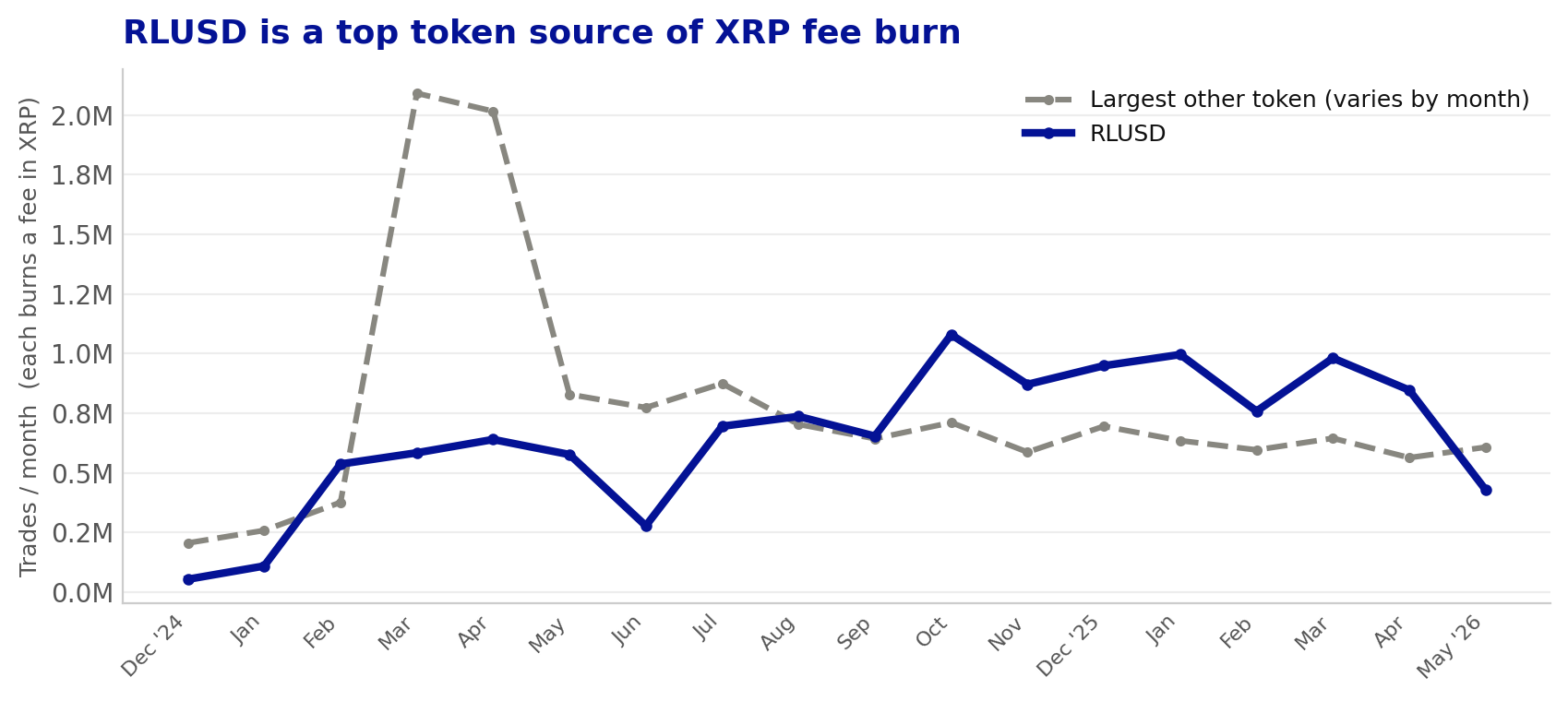
RLUSD vs the largest other issued token traded on XRP each month, by distinct DEX transactions (the largest competitor varies month to month; XRP excluded). Each transaction burns a fee in XRP, so trade count is a proxy for the XRP each token’s activity burns. Source: Dune Analytics (xrpl.dex_swaps).
4. A maturing market
RLUSD liquidity has also matured in where it trades. At launch it traded almost entirely on XRP’s order book; through early-to-mid 2025 it migrated into automated pools (peaking near 76% of fills in April 2025), then reversed — by 2026 the order book had reclaimed roughly 80%. A shift back toward the order book typically points to tighter spreads and more active, professional market-making.
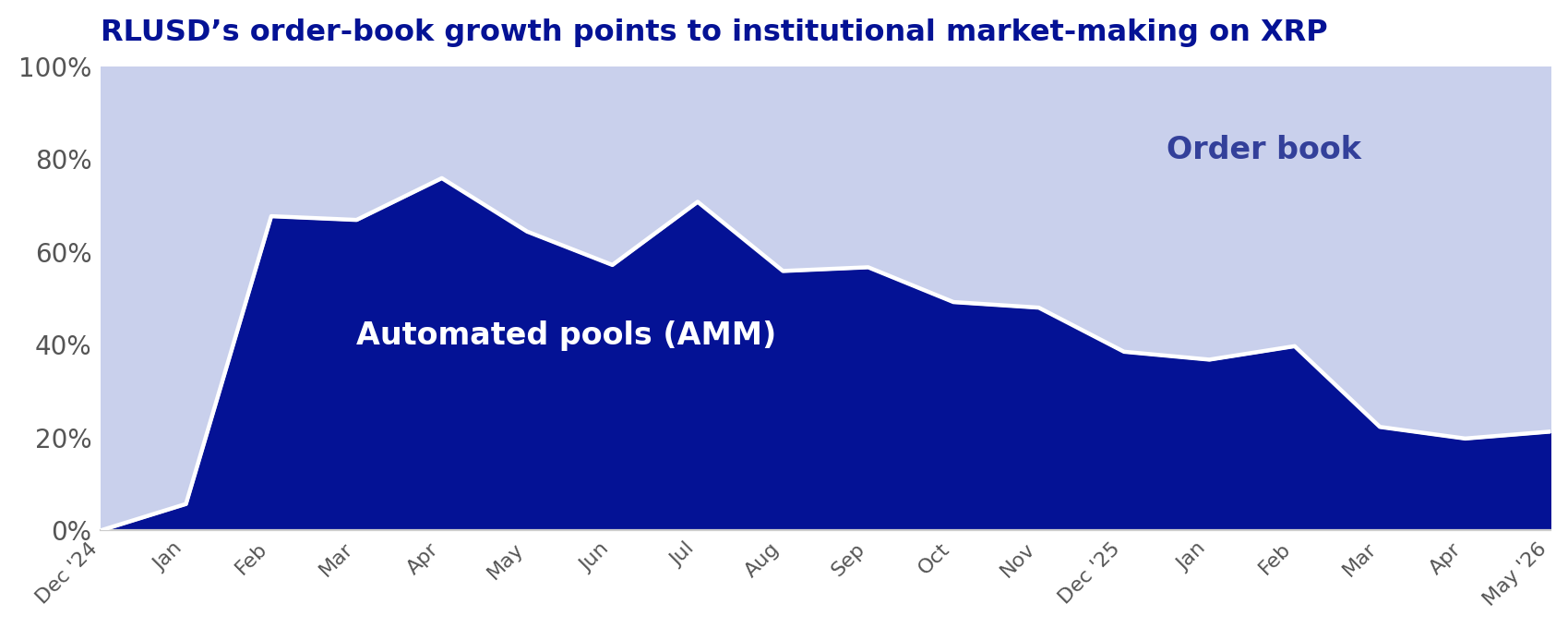
Share of RLUSD trade fills executed in automated pools (AMM) vs the order book, per month. Full months through May 2026. Source: Dune Analytics (xrpl.dex_swaps).
5. RLUSD is scaling fast on XRP
RLUSD’s footprint on XRP has scaled rapidly, from about $20 million at the end of 2024 to roughly $800 million by late June 2026. The clearest gauge is against Ethereum, where RLUSD launched first and most of it lived: in June 2026, it overtook Ethereum to hold a slight majority — about 51% — of all RLUSD in circulation, up from roughly 17% as recently as April 2026.
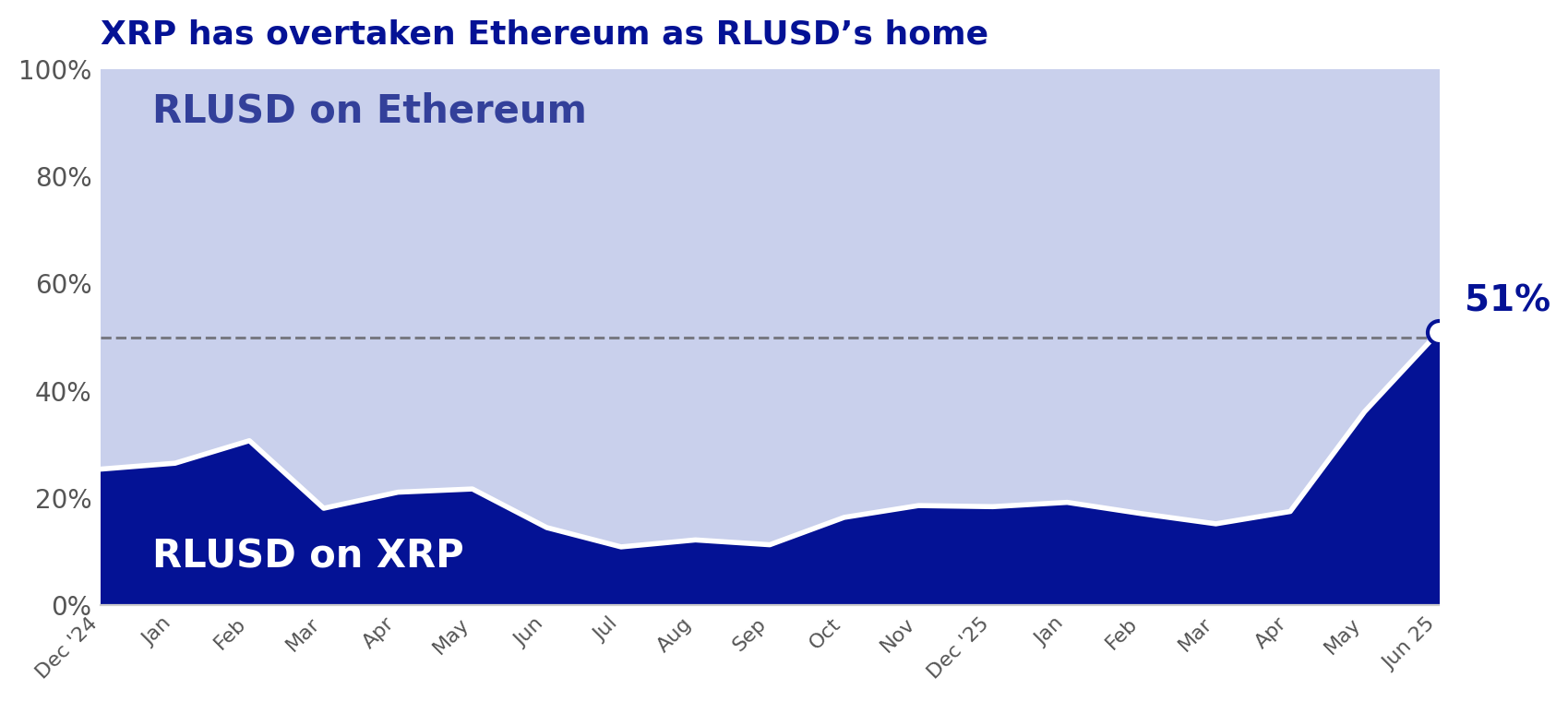
XRP’s share of combined RLUSD circulating market cap (RLUSD on XRP vs RLUSD on Ethereum). Month-end through May 2026; final point is the June 25, 2026 snapshot. Source: Dune Analytics.
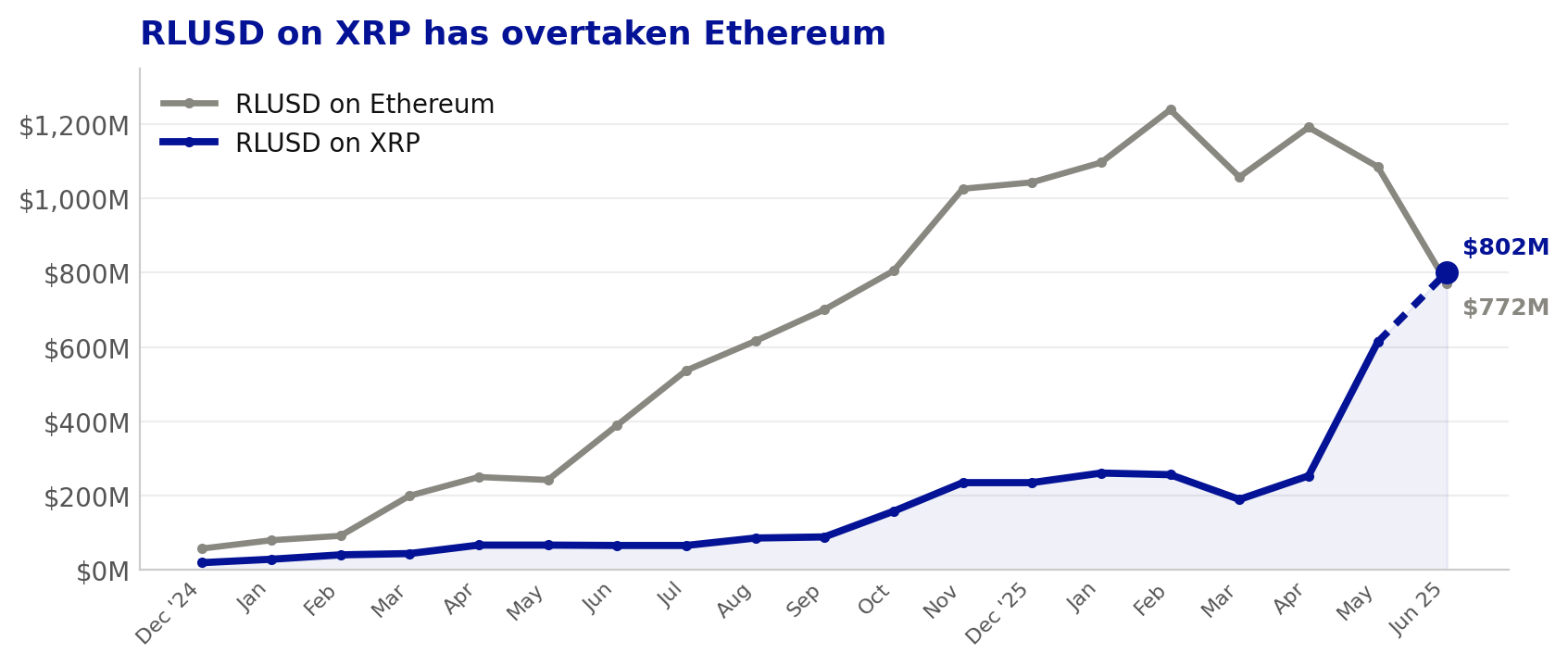
RLUSD in circulation by chain, in dollars. Market cap ≈ circulating supply given RLUSD’s ~$1.00 peg. Month-end through May 2026; final point is the June 25, 2026 snapshot. Source: Dune Analytics (xrpl.transfers; erc20_ethereum).
The crossover reflects a continued rise on XRP and a steep drawdown on Ethereum from its February peak near $1.24 billion. Where issuance moves across chains is driven by issuer and market decisions; the trading and liquidity trends above are presented as parallel developments, not necessarily as the cause of that cross-chain shift.
6. Under the hood, the fundamentals are moving too
More dollars on XRP
RLUSD in circulation on XRP grew from roughly $20 million at the end of 2024 to about $800 million by late June 2026 — roughly a 40-fold increase, with the steepest climb in May and June 2026.
More wallets ready to use it
As of June 25, 2026, RLUSD on XRP was held across 45,527 accounts, with 93,898 trust lines opened to the issuer. Trust lines exceed holders because an account can open the line to hold RLUSD before it carries a balance — a measure of how many wallets are set up to use it.
Bigger money moving through it
The value of RLUSD settled in direct payments on XRP (including all peer-to-peer and institutional transfers, not just DEX trades) rose from about $68 million in December 2024 to roughly $5.08 billion in May 2026, on the order of a 75-fold increase. The flow is increasingly large-denomination rather than small retail transfers.
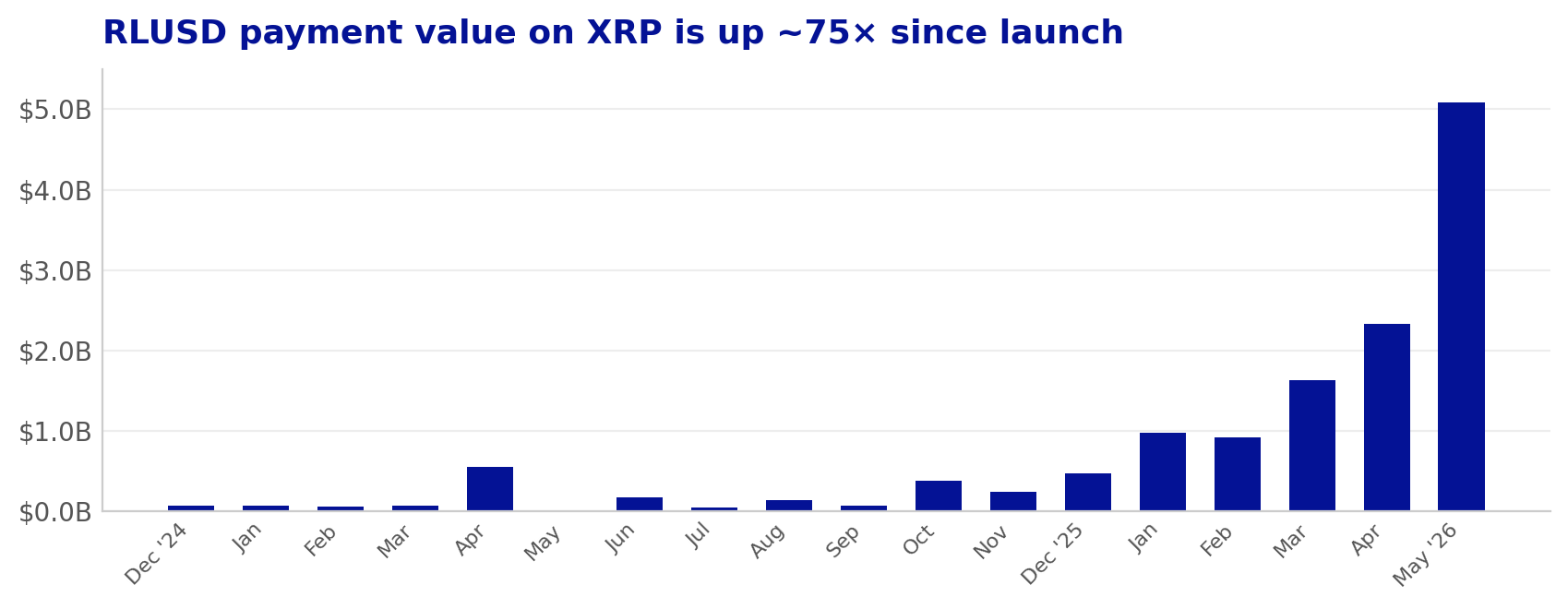
RLUSD settled in direct payments on XRP, per month. Full months through May 2026. Source: Dune Analytics (xrpl.transfers, delivered amounts).
Why this matters
The data shows that RLUSD has become a significant component of on-chain activity on XRP. On XRP, every RLUSD trade, swap, and transfer is an XRP transaction generating trading volume, deepening liquidity, and burning XRP in fees.
For an institution focused on XRP, the takeaway is that a dollar liquidity layer is maturing on the network and a growing share of on-chain trading runs through it. These are developments worth watching, though there is no assurance that current trends will continue.
Methodology and data sources
All on-chain figures are derived from data on Dune Analytics. Monthly (flow) series cover full calendar months only, through May 2026; June 2026 is a partial month and is excluded from monthly charts. Point-in-time levels are reported as of the June 16, 2026 snapshot (with the exception of circulating supply figures) and labeled as such.
- RLUSD on XRP is identified by the issuing account rMxCKbEDwqr76QuheSUMdEGf4B9xJ8m5De (currency RLUSD). Circulating market cap is cumulative issuer net issuance (xrpl.transfers), reconciled to the live holder snapshot (xrpl.token_holders_daily); the two agree to the dollar at $801,796,535 (June 25, 2026).
- RLUSD on Ethereum is the canonical contract 0x8292…85ed; market cap is computed from token mints and burns (erc20_ethereum), approximated as circulating supply given RLUSD’s ~$1.00 peg.
- On-chain trading uses xrpl.dex_swaps. Trade counts and RLUSD’s share are measured as distinct transactions, de-duplicated by transaction hash — “all on-chain trades” is all XRP DEX/AMM transactions, and “RLUSD’s share” is RLUSD-paired transactions as a percentage of them. (dex_swaps records individual order matches, or “fills”; counts are de-duplicated to transactions, the conventional unit.)
- RLUSD traded value is the RLUSD side of each RLUSD trade; the cumulative figure (more than $2.5 billion) sums monthly RLUSD-paired traded value from December 2024 through May 2026. Settled value uses delivered amounts (xrpl.transfers) to avoid partial-payment overstatement.
- Token comparison counts the distinct DEX transactions in which each issued token (currency + issuer) is a leg, by month (XRP excluded); the “largest other token” is the single biggest such token each month and varies over time. Because every XRP transaction pays a fee that the network destroys, transaction count also proxies the XRP each token’s activity burns.
- Venue mix is the share of RLUSD trade fills executed in AMM pools versus the order book (xrpl.dex_swaps).
- The foreign-exchange comparison — the U.S. dollar on roughly 88% of global FX trades — is from the Bank for International Settlements Triennial Central Bank Survey (April 2022). Gold and oil are conventionally quoted in U.S. dollars in global benchmark markets.
Source queries are linkable and analysts credited: market cap (XRP) · market cap (ETH) · DEX trades & share · XRP fee burn · RLUSD traded value · top pairs · settled value. Analysis by Evernorth on Dune Analytics.
Important disclosures
Evernorth Holdings Inc. holds approximately 473 million XRP. Its proposed business combination with Armada Acquisition Corp. II has not yet closed, and Evernorth's securities are not yet publicly tradable. Ripple Labs, the issuer of RLUSD, is a strategic investor in Evernorth and has contributed XRP to Evernorth's predecessor entity. Evernorth has a direct financial interest in both XRP appreciation and RLUSD adoption.
This report contains forward-looking statements regarding RLUSD’s growth, XRP network activity, and on-chain financial infrastructure. These statements involve risks and uncertainties, and actual results may differ materially. For risk factors, see Evernorth's Registration Statement on Form S-4 filed with the SEC. All on-chain data is sourced from Dune Analytics and has not been independently audited. Past activity is not indicative of future performance or asset values.
This content is for informational purposes only and does not constitute investment advice, an offer to sell, or a solicitation of an offer to buy any securities or digital assets. Digital assets involve a high degree of risk, including potential loss of principal.